
How Much Does It Cost to Build a House in Florida?
The cost to build a house in Florida runs from about $150 to $300 per square foot for standard to semi-custom homes, by one 2026 estimate. The national average is about $162 in NAHB's 2024 survey. Large premium homes in greater Miami are priced above that range, before land and most fees.
This guide is for owners who have a lot in Miami-Dade, Broward or Palm Beach, or plan to buy one. It covers price levels by lot type and the hurricane and flood rules of South Florida. It also covers county fees, the contract and legal terms that protect your money, and a five-step method for your own budget.
Most figures come from the NAHB cost survey, the Florida Building Code, Florida Statutes, county fee schedules, Fannie Mae and realtor association reports. The price levels for large premium homes are Florida Home Build's own, a custom home builder focused on greater Miami, and the Florida per square foot ranges are blog estimates, labeled as such.
What is the average cost to build a house in Florida in 2026?
NAHB's survey is national, and its sample is too small for a state breakdown, so a Florida number comes from market estimates. This section sets the national survey beside the Florida estimates that exist.
NAHB's 2024 Cost of Constructing a Home survey puts the construction cost of a typical new single-family home at $428,215, which is 64.4% of the average sales price. The survey rests on responses from 41 builders across the country, so it is a broad national guide.
The Florida rows below come from a real estate blog and an estimating-software vendor that cite no primary source, so read them as planning ranges.
The statewide row is one vendor's estimate for the whole state. The same vendor says a custom build in Miami Beach can run $500 to $1,000 or more per square foot, and the price levels for large premium homes start where the custom row ends.
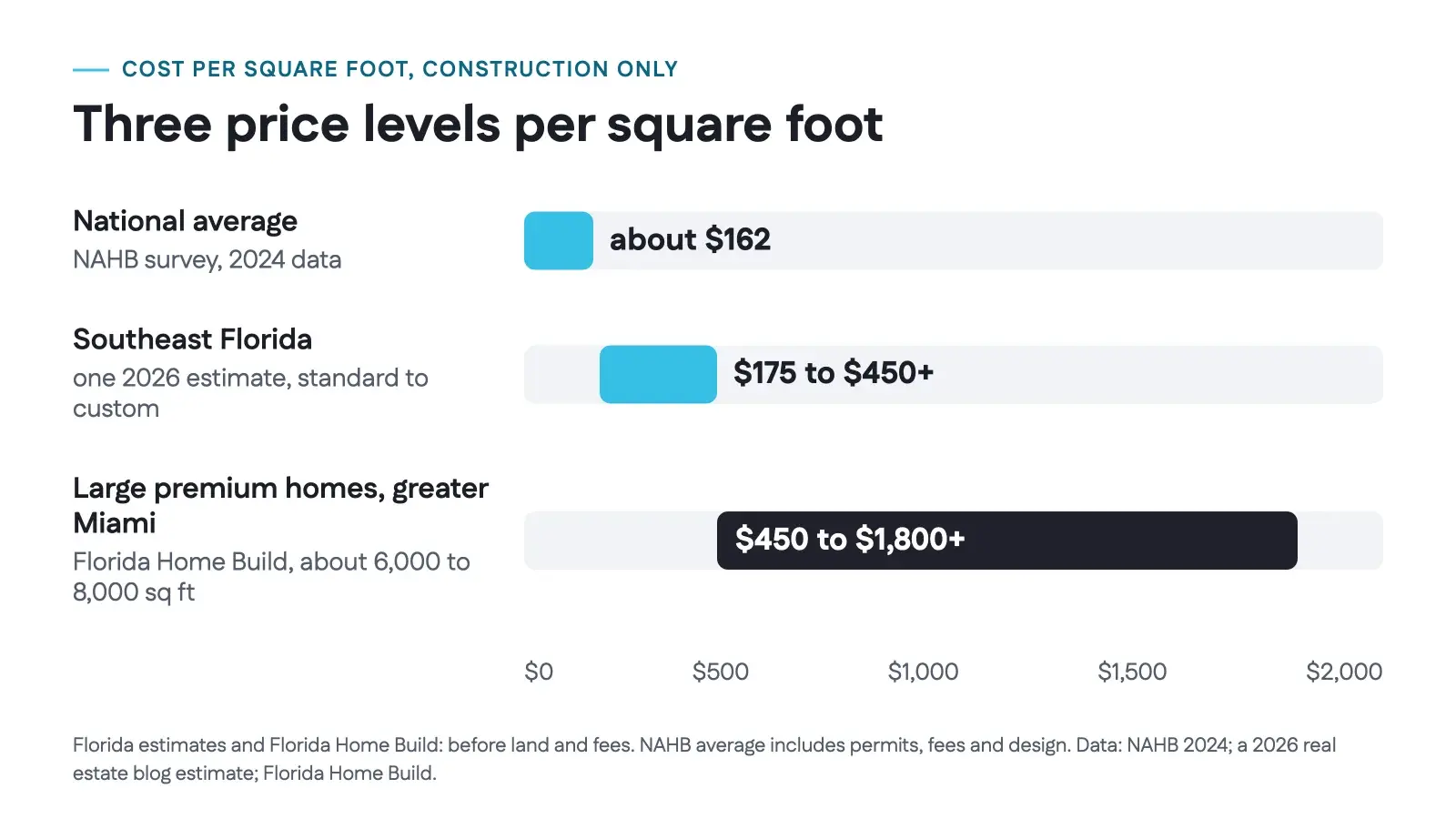
What does a price per square foot include?
A price per square foot usually covers hard costs, meaning materials and labor, on finished living area. What else sits inside depends on the source, so two numbers can describe different things.
NAHB calculates its $162 on finished floor space, and the average home in its survey has 2,647 square feet. Its construction cost already includes $7,640 of building permit fees, $6,367 of impact fees, $6,260 of water and sewer fees and inspections, $6,480 of architecture and engineering, and $9,269 of landscaping. Under the appraisal standards of Fannie Mae and Freddie Mac, as described by the National Association of Realtors, garages, porches and patios are excluded from gross living area. Before you compare two quotes, check that both builders multiply by the same area.
Soft costs are items around the build such as legal and professional fees, insurance and development fees. Florida Home Build's construction pricing leaves out the following:
- the lot
- architecture and design
- permits, surveys and government fees
- furniture
- landscaping
What do the hurricane and flood rules require in Miami-Dade and Broward?
Miami-Dade and Broward are the only Florida counties in the High-Velocity Hurricane Zone (HVHZ), the part of the Florida Building Code with its own structural provisions. Homes there are designed for 175 and 170 mph winds, and every opening and the roof need tested products.
Under the 8th edition of the Florida Building Code, in force through December 30, 2026, the rules differ by county.
In Miami-Dade the product approval in the table is a Notice of Acceptance (NOA) from the county's Product Control Section, which reviews windows, exterior glazing, wall cladding, roofing, exterior doors and shutters, among other products. An NOA means the product meets the zone's requirements for winds of up to 175 mph for typical buildings. A separate guide explains how storm resistant houses are built.
In most Florida flood hazard areas, the lowest floor of a new house must sit at or above the base flood elevation plus 1 foot. The base flood elevation is the flood height the flood map assigns to your lot, and a higher local design flood elevation becomes the minimum.
Miami Beach's 2016 ordinance defines freeboard, the extra height above the flood level, as a minimum of 1 foot and a maximum of 5 feet. In A-zones, the mapped high-risk flood areas, the lowest finished floor of a new house must sit at or above base flood elevation plus the minimum freeboard. The current city code is worth checking before design starts.
Published primary sources give no South Florida figure for the added cost of HVHZ compliance.
What does a custom home cost on a mainland, waterfront or oceanfront lot?
For large custom homes, Florida Home Build prices construction at $450 to $650 per square foot on mainland lots. Waterfront and island lots are priced at $900 to $1,300, and oceanfront lots at $1,300 to $1,800 or more, for homes of roughly 6,000 to 8,000 sq ft.
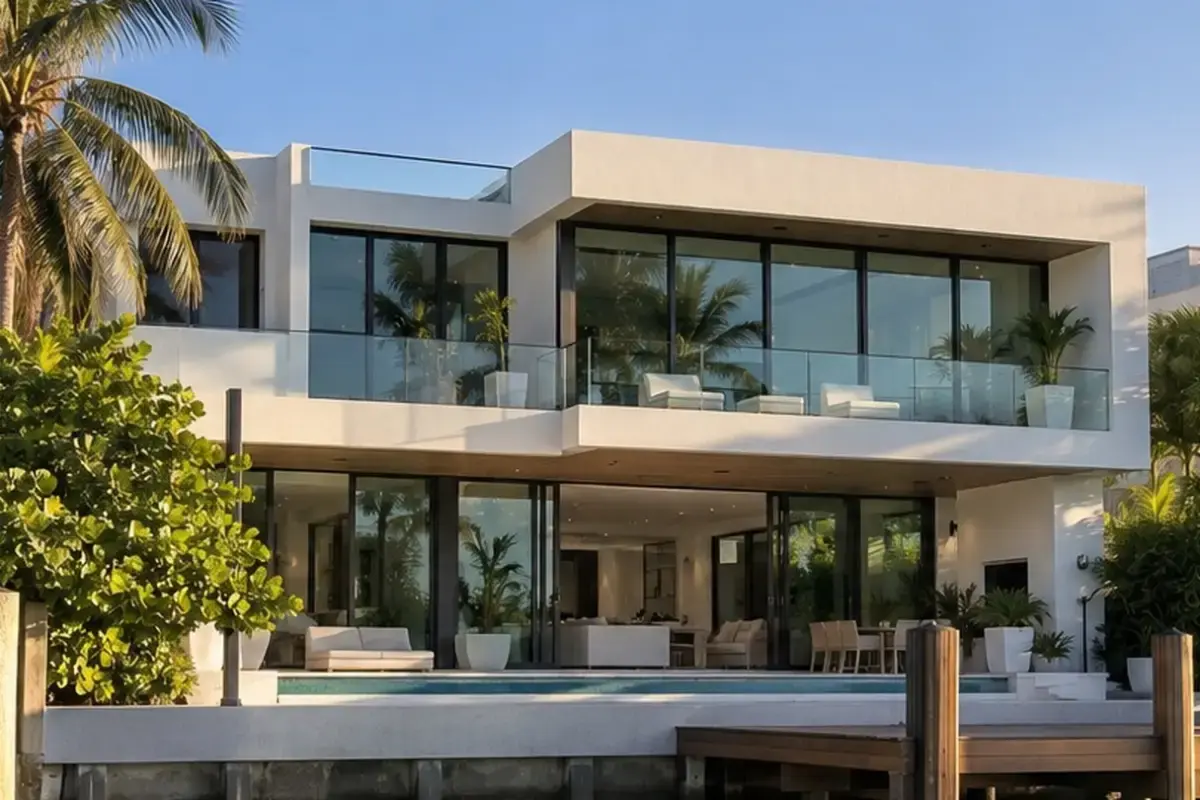
Applied to a 6,000 sq ft home, the company's levels give the totals below, before land, design and fees.
Florida Home Build publishes no per square foot level for homes outside that size range. For a smaller premium home, such as one of about 5,000 sq ft, the Custom or luxury column of the size table below is a rough reference only, and a written quote on your own plans sets the price. The exclusion list applies to every row, and a pool, seawall or dock is worth confirming in writing as inside or outside the price.
Two of the company's pages cover the building process: custom home building in Miami for mainland lots and waterfront construction for lots by the water.
How much does it cost to build a 2,000 or 3,000 sq ft house in Florida?
According to one 2026 estimate for Southeast Florida, a 2,000 sq ft house costs about $350,000 to $900,000 or more to build. A 3,000 sq ft house costs about $525,000 to $1,350,000 or more, from standard to custom finishes, before land and fees.
The table multiplies common sizes by the Southeast Florida finish levels from the first section.
These amounts cover construction only. A waterfront or oceanfront house of this size has no published price level.
What permit and impact fees do you pay in South Florida?
In unincorporated Miami-Dade a new home pays permit fees and impact fees, and impact fees are one-time charges that fund roads, schools, parks and emergency services. For a 4,000 sq ft house the two come to about $23,000 to $26,500, and the impact fees are due before the permit is issued.
The Miami-Dade impact fee schedule lists the amounts below for a new detached single-family home, and the permit fees come from the county's schedule effective October 1, 2026.
For a 4,000 sq ft home, impact fees come to about $17,900 to $21,000. Building and trade permits add about $5,400: $3,940 for the building permit, $572 for plumbing, $452 for electrical and $452 for mechanical. The total leaves out the 2% mobility administrative fee and the water hookup.
The county collects fire impact fees except in Miami, Miami Beach, Hialeah, Coral Gables and Key Biscayne, and most cities collect park and police fees directly. A lot inside a city adds the city's own schedule to the county figures.
Water and sewer hookups are connection charges outside the county impact fees. An undated county brochure is written for homes switching from well water. It lists one-time water connection charges of $291.90 under 3,001 sq ft, $430.90 from 3,001 to 5,000 sq ft and $708.90 above 5,000 sq ft, plus a $90 allocation fee. The Water and Sewer Department sets the charge for a new connection.
In unincorporated Palm Beach County, under the schedule effective January 1, 2026, a new home of 2,000 to 3,599 sq ft pays $9,743.91 in parks, library, public building and school impact fees. A home of 3,600 sq ft or more pays $7,909.23, the lower amount the schedule lists for the larger size band. Fire rescue and law enforcement patrol add $393.30 and $182.61, or $575.91 together, and the road impact fee is a separate $5,597.40 per single-family detached home.
In Broward, school impact fees have gone directly to the School Board of Broward County through its online portal since November 2025. The county and city schedules list the other fees.
How much do the lot, site work and design add to the budget?
National figures give a rough check: in NAHB's survey the finished lot averaged $91,057, and an architect typically charges 8 to 15% of construction cost for a new home.
- Lot. The $91,057 finished lot in NAHB's survey is 13.7% of an average sales price of $665,298.
- NAHB's site work group. The survey's site work line of $32,719 (7.6% of construction cost) is mostly fees and design: permits, impact fees, water and sewer, and architecture and engineering. Excavation, foundation, concrete, retaining walls and backfill are a separate $43,002 (10.0%).
- Fill, lot elevation and piles. Piles are deep foundation posts driven into the ground. Published sources give no reliable South Florida figure for these items, and the company's exclusion list does not name them, so a written quote for your lot should show whether they sit inside the price.
- Sewer. Under section 381.0065 of the Florida Statutes, a public sewer counts as available if your lot can connect to it, it has adequate permitted capacity and no state environmental moratorium applies. The line must also run in a public easement or right-of-way that abuts the property line.
- Design. The American Institute of Architects (AIA) ties the 8 to 15% range for new construction to the architect's experience, the project's complexity and geography.
How does the contract type change what you finally pay?
A fixed price sets the total upfront. Cost-plus with a guaranteed maximum price (GMP) pays the contractor the cost of the work plus a fee, up to a ceiling for the scope written in the contract.
Florida Home Build works on a cost-plus-fixed-fee contract with a GMP, where the fee is a fixed amount. The owner keeps savings below the cap, and the contractor pays overruns above it for the scope in the contract. Every subcontractor bid, change and invoice is visible to the owner in a shared cost tracker.
The company is paid in 4 installments, each for an approved stage: at signing, at the start of work, at the midpoint and at about 99% completion. The share of the contract price for each installment is fixed in the contract. If the first installment is more than 10% of the price, the permit and start deadlines in the next section apply.
Before you sign any building contract, check four things: the guaranteed maximum price and the exact scope it covers, every allowance listed by item, how a change order is priced before work starts, and whether you can see each subcontractor bid and invoice.
Which Florida laws protect your money during the build?
Florida requires a contractor who takes more than 10% upfront on a home to apply for permits within 30 days and start within 90 days of permits. Lien law documents show who can seek payment from your property and whether they were paid.
A lien is a legal right an unpaid subcontractor or supplier can place on your property to secure payment. Section 489.126 of the Florida Statutes covers the first two items on the list below. This is general information, and a Florida construction attorney can confirm the details for your contract.
At signing:
- The 10% rule allows longer periods for just cause or when you agree to them in writing.
- A contractor who has been paid more than the value of the work done may not stop work for 90 days, or for any other period the contract names.
- The contract must carry a written statement of your rights under the Florida Homeowners' Construction Recovery Fund, unless the labor and materials do not exceed $2,500.
- A direct contract above $2,500 for a one-to-four-unit home must carry a bold Construction Lien Law notice. It warns that you can be liable for unpaid subcontractors and suppliers even after paying the contractor in full.
Before work starts, you record a notice of commencement, the public record that work is about to start, with the county clerk. A certified copy, or a notarized statement that it has been filed, goes up at the site.
Before the final payment:
- Subcontractors and suppliers who want lien rights must serve you a Notice to Owner within 45 days after they start work or deliveries, and it must reach you before the final payment.
- The contractor must give you a final payment affidavit. It states that every subcontractor or supplier who served a Notice to Owner has been paid in full, or names those who have not and the amounts due.
If you plan to act as your own contractor, the owner-builder checklist covers what changes on your side.
How does a construction loan change your budget in Florida?
A single-closing construction-to-permanent loan closes once and becomes a mortgage when the house is done. Fannie Mae allows no more than 12 months of construction in any one period and 18 months in total.
Under the Fannie Mae Selling Guide, if the loan is more than 80% of the home's value, the minimum contribution has to come from your own funds. For a one-unit principal residence, gift, grant or employer funds may also count.
Florida Home Build's own construction phase runs 16 to 22 months, and the upper end is past the 18-month ceiling, so a large premium project may need a different loan structure. Your lender sets the actual terms.
In Miami-Dade, Broward and Palm Beach the 2026 conforming limit for a one-unit loan is $832,750, the largest loan Fannie Mae and Freddie Mac can buy. A custom-home loan above that amount generally means a jumbo loan, a mortgage above the conforming limit. The construction totals in the lot-type table sit far above that limit.
Is it cheaper to build or buy a house in Florida?
Construction alone for a standard 3,000 sq ft house is $525,000 to $675,000, close to the $659,000 median for a single-family home in the Miami metro area in September 2026. That median includes land, so the lot and fees decide which path costs less.
County figures come from Miami REALTORS, and the metro and statewide figures from Florida Realtors. Medians mix homes of every size and age and describe the market as a whole. A mid-range 3,000 sq ft house alone costs $705,000 to $840,000 to build.
Building makes sense when a floor plan, a lot position or a wind and flood specification is something resale homes in your area lack.
How long does it take to build, and how does time add cost?
Nationally, homes built by hired contractors took about 11.7 months from permit to completion in 2025, and homes over 6,000 sq ft about 16.3 months. Every extra month adds loan interest and exposure to rising material prices.
- Census times. In NAHB's analysis of Census data, homes of 4,000 to 4,999 sq ft took about 10.7 months in 2025. Homes of 5,000 to 5,999 sq ft took about 12 months.
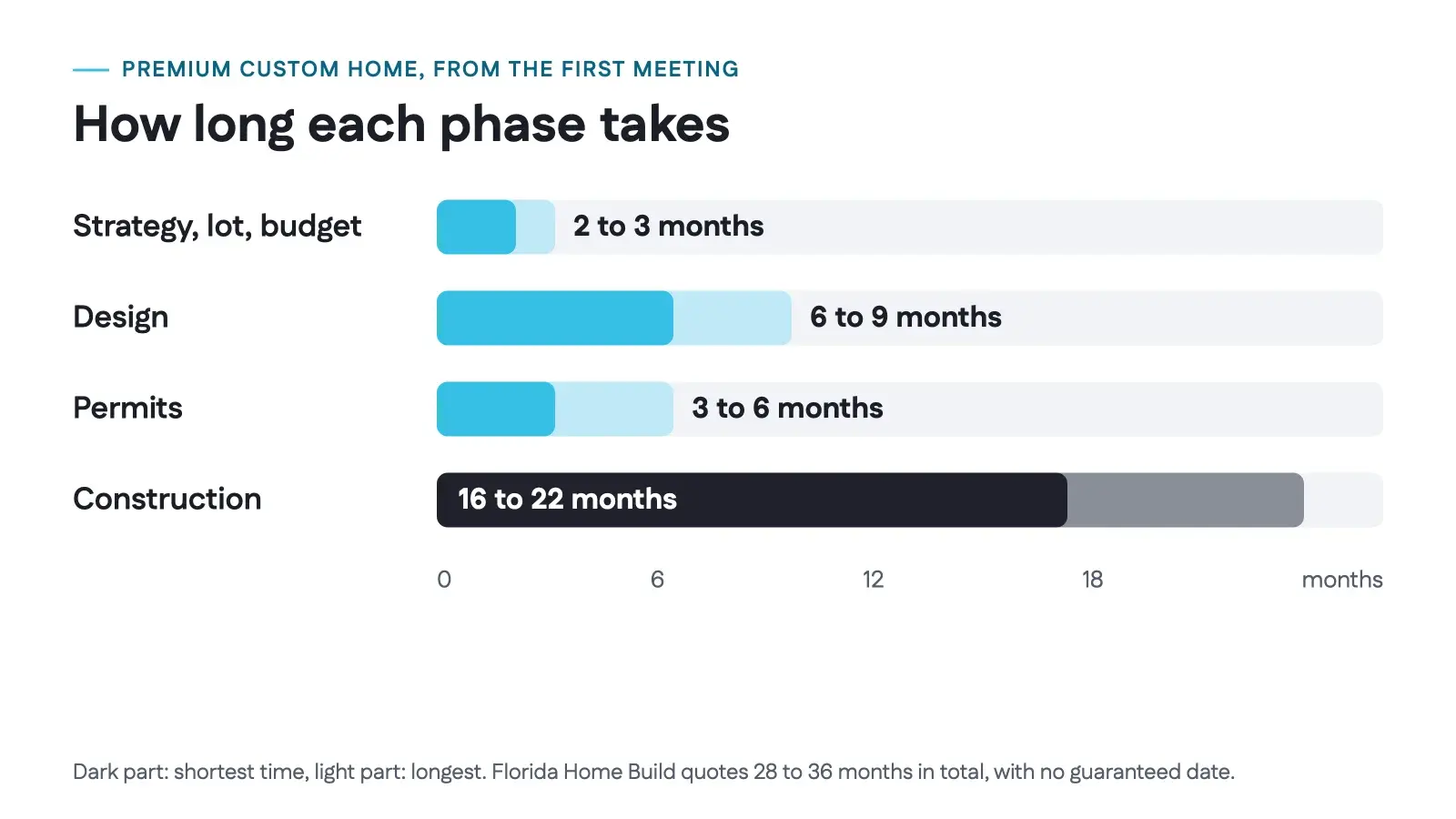
- A premium project from the first meeting. The company plans a custom home in phases. Strategy, lot and budget take 2 to 3 months and design 6 to 9 months. Permits take 3 to 6 months and construction 16 to 22 months. The phase ranges add up to 27 to 40 months, and the company quotes 28 to 36 months from the first meeting to move-in, with no guaranteed date. Census counts only from permit to completion. The steps to building in Florida explain the full sequence.
- Permit review. Under section 553.792 of the Florida Statutes, a local government using its own plans reviewer must decide on a complete single-family application within 30 business days for a structure under 7,500 sq ft. At 7,500 sq ft or more the deadline is 60 business days. After a missed deadline the permit fee drops by 10% for each business day of delay, with exceptions for delays the applicant caused or agreed to.
- Material prices. In July 2026 residential building material prices nationally were up 5.0% from a year earlier, the highest annual increase since December 2022. Softwood lumber was up 17.3%, and the price index for inputs to new residential construction was up 6.5%.
Which budget mistakes do owners make, and how big should the reserve be?
Allowances set too low and changes made after construction starts are the two places where a budget can break, and a reserve absorbs what remains. AIA calls a 5 to 10% contingency common in design-build projects, where one firm designs and builds.
- Allowances. An allowance is an amount in the contract for items you have not chosen yet, such as tile, fixtures or lighting. If the product you pick costs more than the allowance, the contract sets how the difference is paid, so choosing finishes before signing keeps allowances close to what you will buy.
- Changes after construction starts. A change in scope after work begins is priced as a change order. A guaranteed maximum price covers the scope written in the contract, and a change outside that scope is priced on top of the cap.
- Reserve. The AIA range describes a contractor's contingency, and AIA gives no single figure for an owner's reserve. This guide assumes a 5 to 10% reserve of construction cost, set higher when the lot or design carries more unknowns.
How to estimate your own budget in 5 steps
Multiply living area by the price level for your lot, add design and county fees, hold a reserve, then add the lot. At Florida Home Build's mainland level, a 6,000 sq ft home in unincorporated Miami-Dade comes to about $3.1 million to $4.9 million before the lot and the other excluded items.
- Multiply living area by the price level. For a home of roughly 6,000 to 8,000 sq ft, use the company's level for your lot type. For a smaller house on a standard lot, use the Southeast Florida levels in the size table. Any other house, including a smaller one on the water, needs a written quote.
- Add design. Use the architect range from the section on the lot, site work and design.
- Add county fees. Use the fee tables for your county and check which of them your city collects. Florida Home Build handles city and county permits and inspections for the owner, and the fees themselves sit outside the construction price.
- Hold a reserve. Size it with the reserve section above.
- Add the lot and the excluded items, then test the total against your financing. Furniture, landscaping, surveys and any site work quoted separately go here, and the loan section shows the limits you will meet.
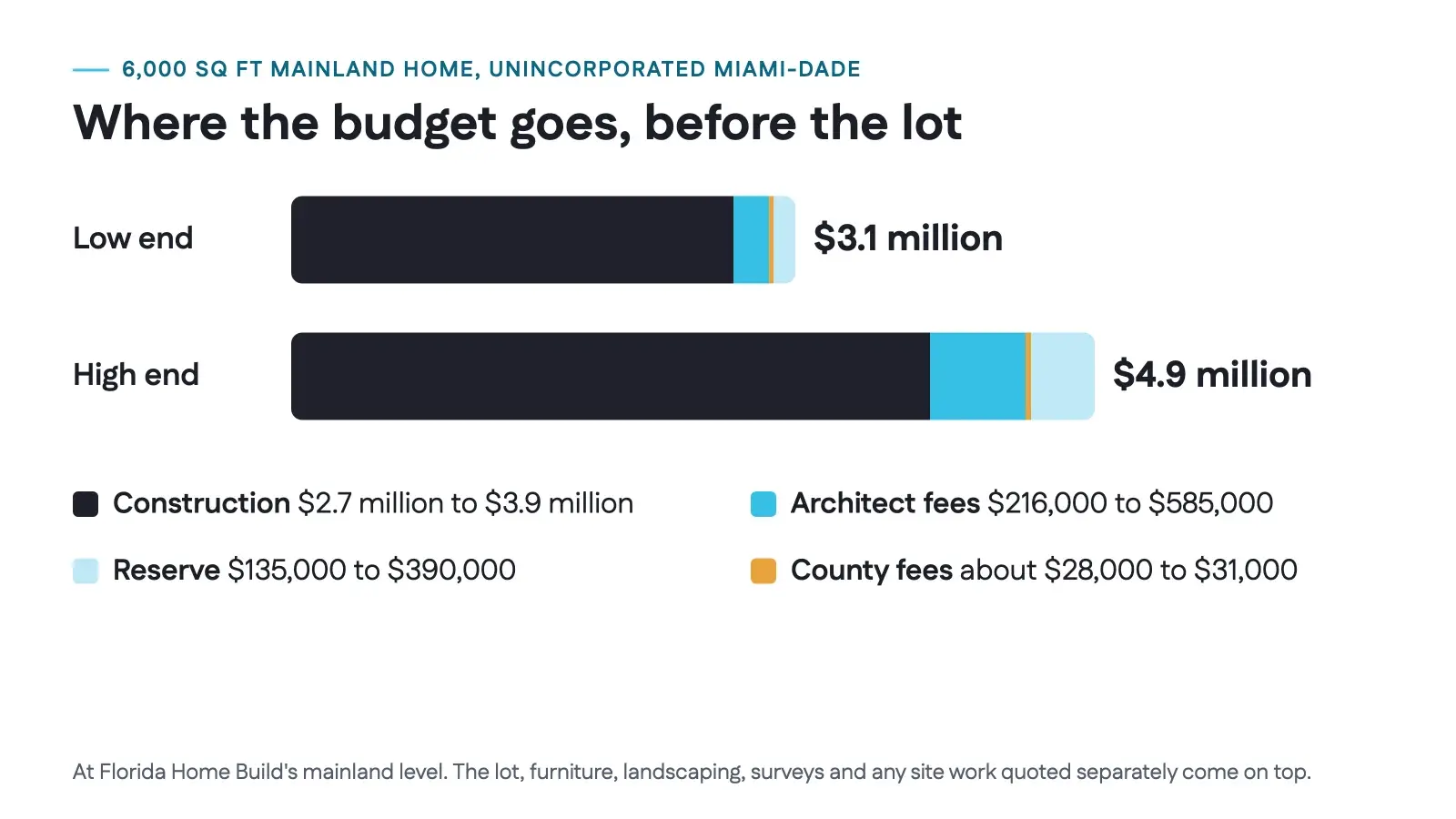
The four priced lines for that 6,000 sq ft mainland home are:
- Construction at $450 to $650 per sq ft (mainland row of the lot-type table): $2.7 million to $3.9 million
- Architect fees of 8 to 15%: $216,000 to $585,000
- County impact and permit fees: about $28,000 to $31,000
- Reserve of 5 to 10%: $135,000 to $390,000
For a waterfront or oceanfront lot, the same four lines use that lot's price level. If you have a lot but no plans yet, the company's process starts with strategy, lot and budget, a phase of 2 to 3 months. If you already have plans, the next step is a written budget for your own site that lists every exclusion, and the custom home service page covers the company's custom home service.
Frequently asked questions
Is $300,000 enough to build a house in Florida?
Only for the construction of a small house at standard finish. The size table puts a 1,500 sq ft house at $262,500 to $337,500 and a 2,000 sq ft house at $350,000 to $450,000. Those figures exclude land, design and fees, so $300,000 will not cover a full project that includes the lot.
Is there a cost to build a house in Florida calculator by zip code?
Yes, such tools exist, and many of them multiply your area by an average price per square foot. A zip code cannot show your lot type, wind and flood rules, county fees or contract terms. The five steps above use the same multiplication and add the lines an average price leaves out.
How much does it cost to build a house on land you already own?
Owning the land takes the lot purchase out of your budget, and the construction price stays the same. Site work, design, county fees and a reserve still apply, and the fee section above shows when the county fees fall due before construction can start.
Will the new 2026 Florida Building Code change what I pay?
The Florida Building Code 9th edition takes effect on December 31, 2026, and Miami-Dade requires permit applications and plans submitted on or after that date to comply with it. Whether that changes your price depends on your design, and your architect can check the plans against the new edition before you apply.
25.10.2026