
How Long Does It Take to Build a Custom Home in Florida?
How long does it take to build a custom home? A home built by a hired contractor took about 11.7 months from permit to completion in 2025, according to NAHB's analysis of Census data. Homes over 6,000 sq ft took 16.3 months, and Florida Home Build plans 28 to 36 months from first meeting to move-in for a premium home.
This guide is for owners of a lot in Miami-Dade, Broward or Palm Beach. It sets national build times next to the Florida rules that stretch a schedule: permit review, expiry dates, hurricane season, inspections and loan terms. The phase ranges for a premium custom home come from Florida Home Build, a custom home builder in greater Miami, and are planning figures without a guaranteed date.
How long does it take to build a custom home, on average?
Across all new single-family homes the 2025 national average was 8.8 months from permit to completion, with about 1.4 months of that spent waiting to start. Who builds the house changes the figure: homes built by hired contractors took about 11.7 months.
The Census Bureau's Survey of Construction counts the months between the building permit and completion, and the National Association of Home Builders (NAHB) publishes its yearly analysis of the data.
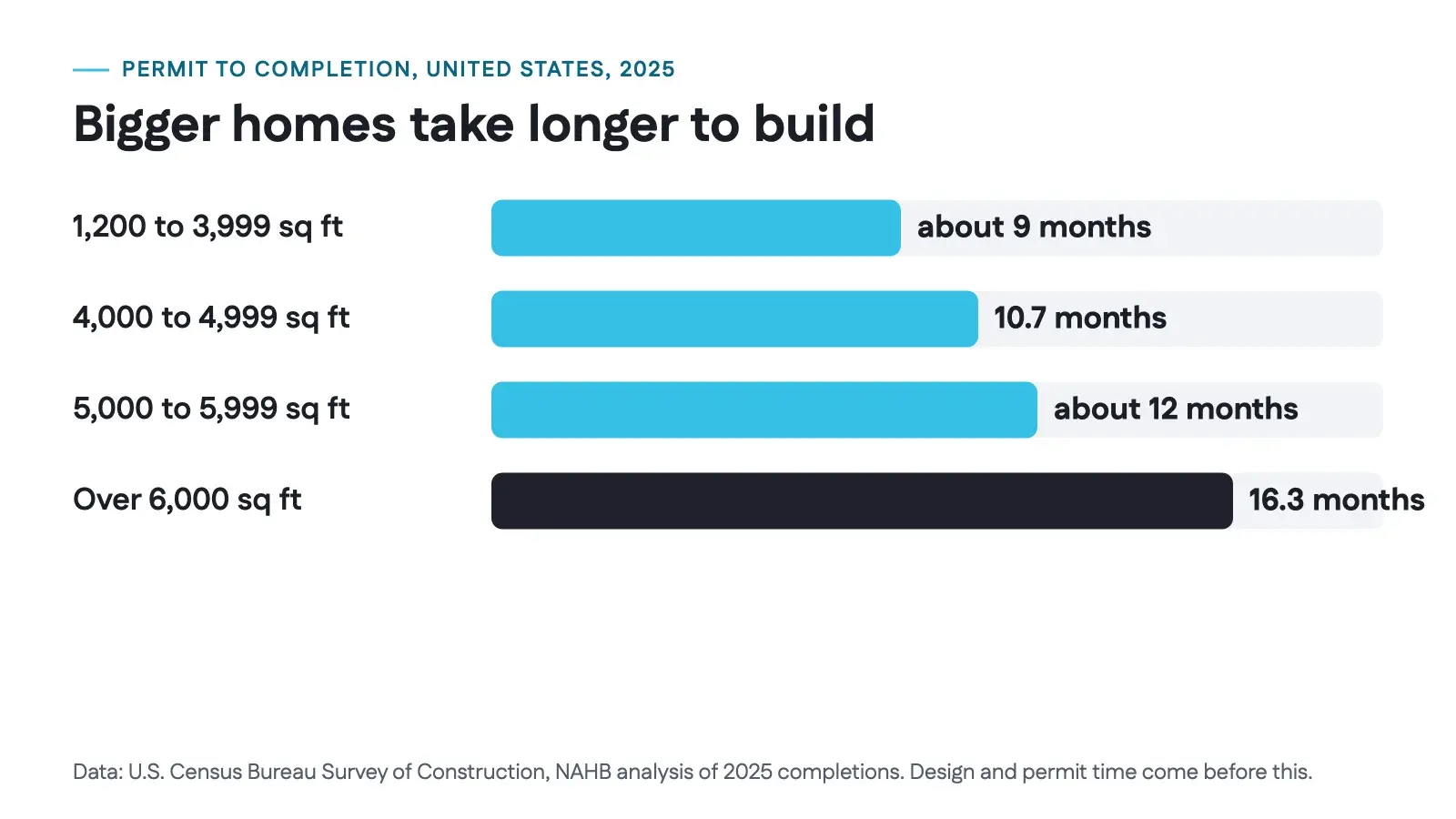
Size changes the figure too. Homes of 1,200 to 3,999 sq ft took about 9 months in 2025 and homes of 4,000 to 4,999 sq ft about 10.7 months. The 5,000 to 5,999 sq ft group averaged about 12 months, and homes over 6,000 sq ft 16.3 months. These size figures are not split by builder type.
Is building in South Florida faster or slower than the national average?
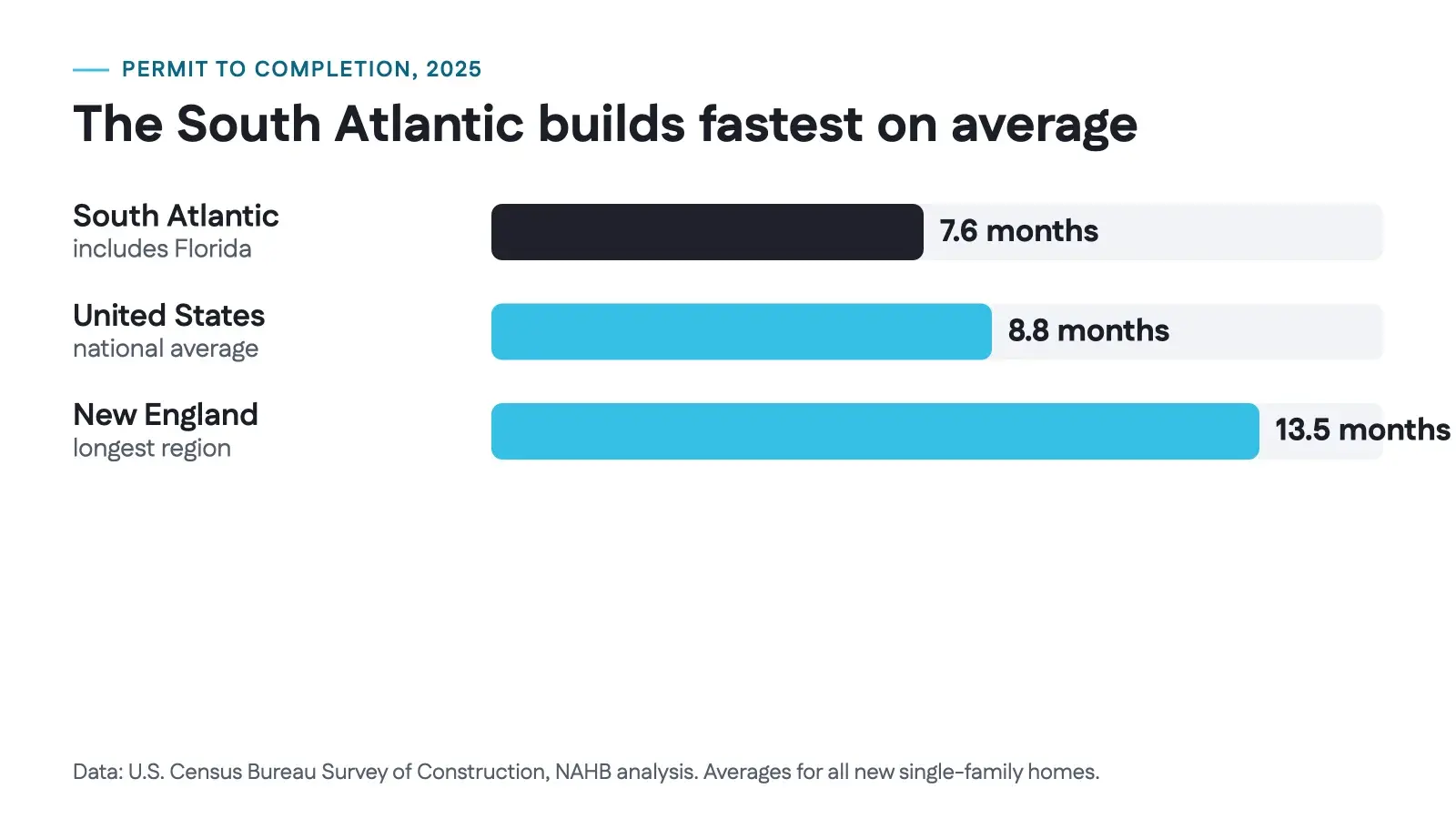
NAHB's analysis gives no figure for Florida alone. The South Atlantic Census division, which includes Florida, had the shortest average in 2025 at 7.6 months from permit to completion, against 8.8 nationally and 13.5 months in New England.
A Census division is a group of neighboring states and jurisdictions that the Census Bureau reports together. The South Atlantic covers Florida, Georgia, the Carolinas, Virginia, West Virginia, Maryland, Delaware and the District of Columbia.
The regional average mixes every size and type of home, so for a large custom home the size figures above are the closer comparison. Under the 8th edition of the code, Miami-Dade and Broward also form the High-Velocity Hurricane Zone (HVHZ). That part of the code has its own structural provisions, explained in the guide on how storm resistant houses are built.
How long does it take to build a custom home, phase by phase?
Florida Home Build plans a premium custom home in four phases: strategy and budget, design, permits and construction. They take 2 to 3, 6 to 9, 3 to 6 and 16 to 22 months, and the company quotes 28 to 36 months in total from the first meeting.
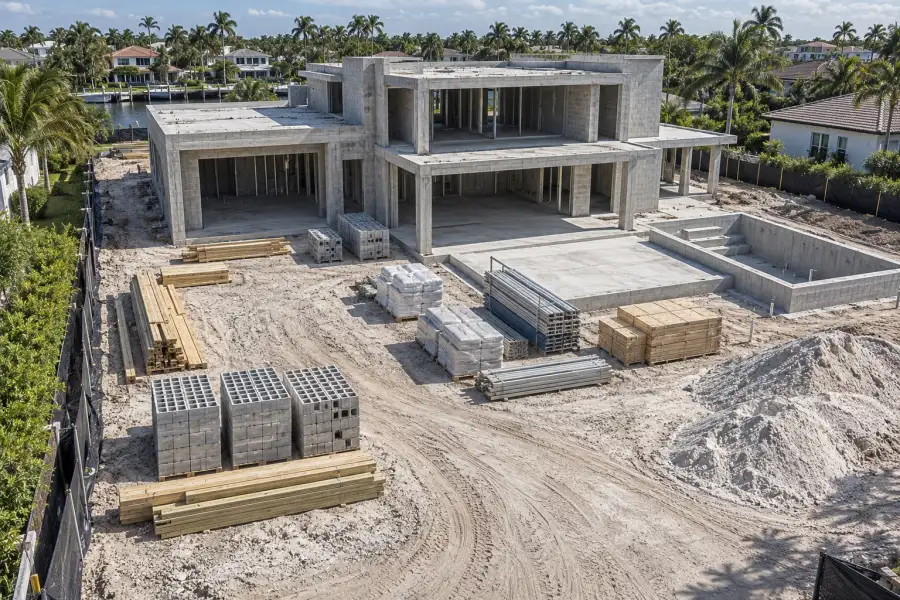
The quoted total is not the plain sum of the four ranges. Construction is the longest phase, and the Census count starts at the permit, so it leaves out the strategy, design and permit phases.
The permit phase is a planning range of 3 to 6 months. The state's review deadlines in the next section are legal clocks that start only with a complete application.
Inspections run through construction. The code's Building volume lists the required inspections of a new building, including foundation, framing, sheathing, roofing and final. It leaves their timing and sequence to the building official, the local authority that approves plans and inspections. The steps to building in Florida guide walks through the same sequence.
Code references in this guide are to the 8th edition of the Florida Building Code, in force through December 30, 2026. The 9th edition replaces it on December 31, 2026. Miami-Dade requires permit applications and plans submitted on or after that date to follow the new edition, so the edition that applies depends on your application date.
How long does a building permit take in Florida?
Florida law gives a local government with its own plans reviewer 30 business days to decide on a complete single-family application under 7,500 sq ft. At 7,500 sq ft or more it has 60 business days, and a missed deadline cuts the permit fee.
The deadlines come from section 553.792 of the Florida Statutes. Five rules shape how the clock runs:
- Completeness notice. Within 5 business days after receiving an application, the local government must say what information is missing. If it does not, the application is deemed complete and accepted.
- Fee cut. If the department misses a review deadline, it must reduce the permit fee by 10 percent of the original fee for each business day of delay. The cut does not apply if the applicant caused the delay, the parties agreed in writing to an extension, or a force majeure applies.
- Corrections. A department avoids the fee cut by sending a written notice within the deadline that states the code reasons the application fails. The applicant has 10 business days to submit corrections, and the department then has 10 business days to decide, or the fee drops by 20 percent for each business day of delay.
- Waivers. The applicant can waive the deadlines in writing, and a local government may not make that waiver a condition of review. Palm Beach County's Building Division publishes a waiver form that lets the applicant agree to extend the review as needed.
- Local rules. A local ordinance can set shorter deadlines than the statute, and then the stricter ones apply.
Broward County's building division says plan review of a single-family residence takes approximately 15 business days, provided all documentation comes with the application. Its planning division FAQ says most major buildings, including single-family residences, need a Development Order before the permit application can be filed. The FAQ describes county review in unincorporated areas, so for a lot inside a city check that city's process.
For a lot in Miami-Dade or Palm Beach, plan around the statutory deadlines unless a local ordinance sets shorter ones. Florida Home Build handles city and county permits and inspections for the owner.
Can a private provider speed up plan review and inspections?
Yes, Florida lets the owner hire a private provider for plan review and inspections. When a provider certifies the plans, the building official has 10 business days to flag incomplete forms, or the permit is deemed approved and must be issued the next business day.
The provider is a licensed private firm or professional the owner pays directly to review plans or inspect the work for code compliance. Under section 553.791, the owner, or the owner's contractor with written authorization, may choose this route at any time. For a single-trade review of a one or two-family dwelling, the period is 5 business days.
Part of the review stays with the local building official. The building official may not re-review plans a provider found code compliant, except for local ordinances, floodplain management regulations, site review and other administrative or life safety review. If the owner uses a provider for plans review, the official may also require one for inspections, under adopted local policy.
The permit fee drops as well. The local government must reduce it by the cost savings it realizes from not performing the review or inspections itself.
Which deadlines can expire while your house is being built?
Under 2026 Florida law a single-family permit expires 1 year after issuance or on the effective date of the next code edition, whichever is later. Miami-Dade's June 30, 2026 memo reads that limit as applying before work starts, and says the permit is extended 180 days after each approved inspection.
- The permit, under state law. A single-family permit issued by a local government expires 1 year after issuance or on the effective date of the next code edition, whichever is later. The local government may extend it and may send the owner and contractor a written notice no less than 30 days before expiry.
- The permit, in Miami-Dade. The county's Board and Code Administration Division told building officials that the 1-year period covers the time before any activity. Once work has commenced, each approved inspection extends the permit by 180 days. That memo is the county's own reading, so for a lot in another county, check the rule with the department that issued the permit.
- The code's own clock. The 8th edition of the code also makes a permit invalid if work does not start within 6 months of issuance. It counts work as in active progress when the permit has an approved inspection within 180 days. Ask the issuing department in writing which rule it applies to your permit.
- Extension fees. Miami-Dade's fee schedule effective October 1, 2026 charges $80.99 for a permit extension requested in writing.
- Notice of commencement. This is a public record the owner files with the county clerk before work begins, and posts on the site, showing that work is about to start. It expires 1 year after recording unless it states a different date. If the contract gives a completion period longer than 1 year, the notice must be effective for 1 year plus that extra period.
- Payments after expiry. Florida law treats any payment the owner makes after a notice of commencement has expired as an improper payment, so its end date needs to cover the whole contract. When the contract is over $5,000, the building department requires a copy of the notice before the first inspection.
- Contractor deposits. A contractor who takes more than 10 percent of the price upfront must apply for permits within 30 days and start work within 90 days after permits are issued. The exceptions are explained in the guide to what Florida law requires.
How do hurricane season and the rainy season affect the schedule?
Yes, the seasons can slow a build, mostly in the outdoor phases. A national homebuilder's guide names heavy rain as a cause of pauses in site preparation and framing, and notes that crews can work indoors once the roof and house wrap are on.
The Atlantic hurricane season runs from June 1 to November 30 and South Florida's wet season from May 15 to October 15. A build of 16 months or more crosses both at least once.
According to the National Hurricane Center, the season peaks on September 10, with most activity between mid-August and mid-October. The National Weather Service in Miami says 60 to 70 percent of the average yearly rainfall falls in the wet season.
Declared emergencies have a legal effect on the calendar. In an area under a Governor's emergency declaration for a natural emergency, Florida law tolls a building permit, meaning its expiry clock stops for the length of the declaration. The law then adds 24 months to the remaining period, up to 48 months for multiple emergencies. The permit holder must notify the issuing authority in writing within 90 days after the declaration ends.
One practical step follows from the dates. Have the builder mark which phases of your schedule fall between June 1 and November 30, and how much slack each of them carries.
Which inspections and flood certificates can hold up construction?
In Miami-Dade every new house has a tie beam inspection hold, and the county says an under-construction elevation certificate with floor, grade and road elevations will be required. In flood hazard areas the Building volume of the state code also requires the elevation certification upon placement of the lowest floor and before further vertical construction.
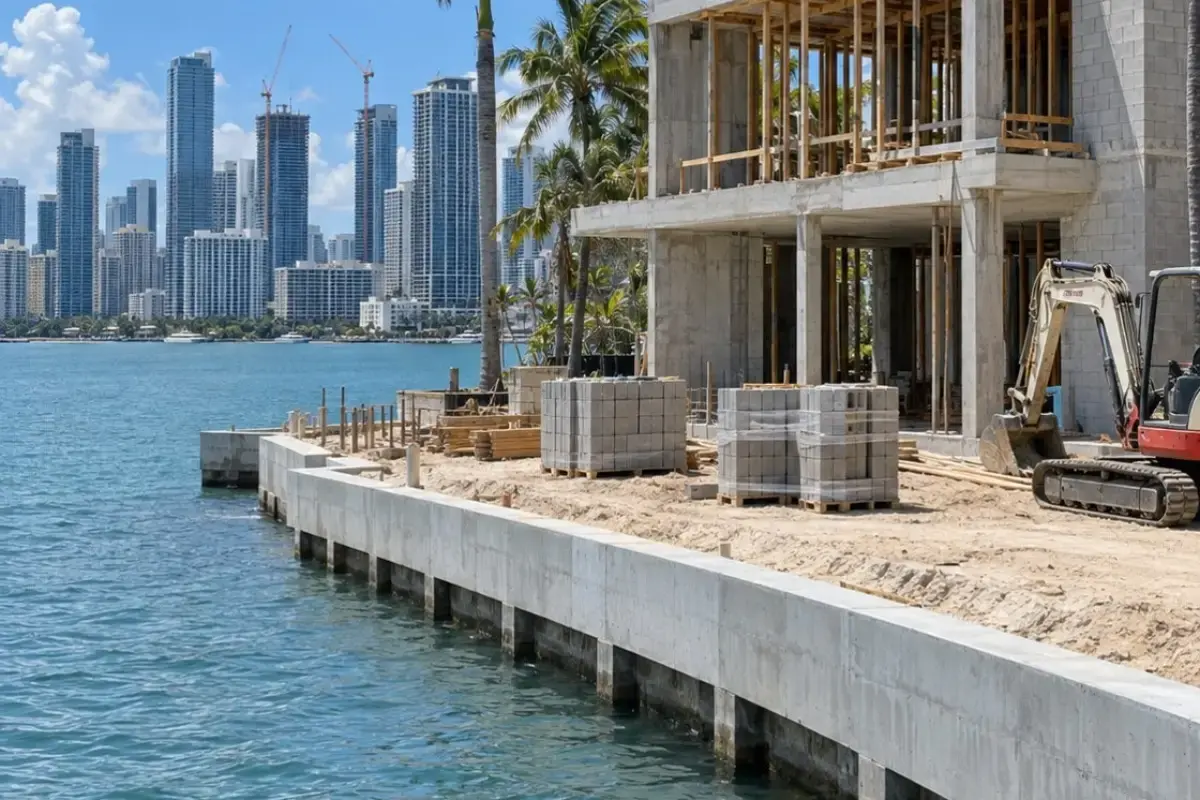
The tie beam is the reinforced concrete beam that runs along the top of the block walls. An elevation certificate is a form from the Federal Emergency Management Agency (FEMA) that records a building's elevations against flood levels. FEMA's instructions say a land surveyor, engineer or architect authorized by state law signs and seals it.
Miami-Dade's elevation certificate page says the county requires an elevation certificate for all new construction and substantial improvements. It has collected the FEMA form from builders as a permit requirement since 1995. The same page states that a tie beam inspection hold, a stop in work until that inspection is passed, is required on all new construction and substantial additions. The hold comes with an Under Construction Elevation Certificate showing floor elevation, adjacent grade elevation and crown of road elevation, the road's highest point.
The state code's Building volume adds the flood hazard rule. It requires the elevation certification to go to the authority having jurisdiction upon placement of the lowest floor and before further vertical construction.
Because Miami-Dade requires the certificate for all new construction, it is worth asking the builder when the tie beam stage is planned and who will prepare the certificate. FEMA's form requires a post-construction certificate when construction is complete.
What happens to your loan and insurance if the build runs long?
For a conforming loan sold to Fannie Mae, more than 12 months of construction in one period or more than 18 in total needs a two-closing loan, with no exceptions. For other loans, ask the lender for the construction period limit.
A conforming loan is a mortgage within the size limits that Fannie Mae can buy. A single-closing construction-to-permanent loan covers the construction loan and the permanent mortgage in one closing. The Fannie Mae Selling Guide limits it to 12 months of construction in any one period and 18 months in total. In a two-closing loan the construction loan closes first, and a second closing sets up the permanent mortgage afterward.
The company's 16 to 22 months of construction can reach past the 18-month total, so a project with a conforming loan sold to Fannie Mae may need the two-closing structure. Loan limits and material prices are covered in the guide to Florida home building costs.
Builder's risk insurance covers the structure while it is being built. Florida's Citizens Property Insurance says its builders risk policy ends coverage at several points. They include acceptance of the property by the purchaser, 90 days after construction is complete, and 60 days after the building is occupied or put to its intended use. A move-in date and a policy end date can therefore fall close together.
Which owner mistakes stretch the schedule?
Changes after signing and missed paperwork dates are the owner-side slips that cost calendar time. According to the American Institute of Architects (AIA), a change order is a written modification signed by the owner, architect and contractor that adjusts price, time or both. An owner-requested design revision is among the common triggers.
The contractor evaluates the impact on cost and schedule before the parties agree. The price side of change orders is covered in the cost guide.
Three paperwork slips appear above. They are a notice of commencement with an end date shorter than the contract, a payment made after the notice expired, and a permit left without an approved inspection for too long.
Owners who act as their own general contractor also carry the schedule themselves, and owner-built homes took 14.3 months from permit to completion in the Census data. The owner-builder checklist lists the steps that role involves.
When can you move in?
You can move in once the building official issues a certificate of occupancy after the final inspection. In a flood zone it also needs the as-built lowest floor elevation, and a temporary certificate can allow occupancy of a finished part earlier.
Under the code, nobody may use or occupy a building until the building official has issued a certificate of occupancy, after inspecting the building and finding no violations. The final inspection is made after the building is completed and ready to occupy.
For a house in a flood hazard area, the certificate of occupancy must state that documentation of the as-built lowest floor elevation has been provided and is kept in the authority's records. The final certification of the lowest floor elevation is part of the final inspection, prepared and sealed by a licensed surveyor and mapper or a registered design professional. FEMA's form adds that a certificate based on a building under construction is followed by a post-construction certificate when construction is complete.
The temporary certificate of occupancy (TCO) allows use of part of the building before all the work is done, if the occupied portion can be occupied safely. The building official sets how long it is valid. In the City of Miami a TCO grants the same rights as a certificate of occupancy for a period that is usually 90, 180, 270 or 360 days, depending on approvals. The city issues the certificate of occupancy for new construction after all final inspections are completed and approved.
How do you keep a custom home build on schedule?
Get a written schedule by phase and check the permit and notice dates yourself, with every change signed in writing.
- Get the schedule in writing by phase. Strategy and budget, design, permits and construction each need a planned length for your project. The contract should say whether the completion date is guaranteed.
- Match the notice of commencement to the contract. Record it before work begins, with an end date that covers the whole construction period.
- Track permit dates. Note the permit's expiry date and every approved inspection, since under Miami-Dade's memo each approved inspection extends the permit by 180 days.
- Ask when the tie beam stage is planned. In Miami-Dade the tie beam inspection hold needs an under-construction elevation certificate, so agree on the date with the builder.
- Require weekly confirmation and check progress yourself. A short weekly note shows what happens next and who is responsible. Photos and inspection results let you confirm progress without waiting for a verbal update.
- Change in writing only. Every change goes through a signed change order that states the effect on time.
Florida Home Build gives owners a client portal with the schedule, photos, inspections and invoices. With a lot and a target date in hand, the next step is to ask the builder for a written phase schedule for your own project. The company builds custom homes through its custom home building in Miami service.
Frequently asked questions
How long does it take to build a 2,000 sq ft house?
Homes of 1,200 to 3,999 sq ft averaged about 9 months from permit to completion in 2025, according to NAHB's analysis of Census data. A 2,000 sq ft house falls in that group, while homes built by hired contractors averaged about 11.7 months. Design and permit review come before that clock starts.
How long does it take to build a 5,000 sq ft custom home?
Homes of 5,000 to 5,999 sq ft averaged about 12 months from permit to completion in 2025, according to NAHB's analysis of Census data. Florida Home Build plans 16 to 22 months of construction for a premium home and 28 to 36 months from the first meeting, without a guaranteed date. Design and permit review come before the Census clock starts.
How long is the wait between the permit and the start of construction?
The national average wait was 1.4 months in 2025. By Census division it ranged from 1 month in the East North Central and West North Central divisions to 1.8 months in New England. NAHB's analysis gives no separate figure for Florida, so ask your builder when work can start after the permit.
How much of my own time will the build take?
Florida Home Build says an owner spends on average 2 to 4 hours a week on one of its projects. For owners who live elsewhere, the company adds stage videos, drone footage and site cameras, so owners can follow progress remotely.
26.10.2026