
Cost of Seawalls in Florida: What You Pay per Foot
The cost of seawalls in Florida starts at $150 to $600 per linear foot in a national cost guide, while 2026 Florida guides put a new wall at roughly $400 per foot and up. Vinyl is the lowest priced of the main materials in the Florida guide and steel the highest, and Broward County and Miami Beach also set minimum wall heights.
Below are the price ranges, the extra lines that show up in a quote, the height rules and the permits that shape a seawall budget for a lot in Miami-Dade, Broward or Palm Beach County.
Prices move from year to year. Use these ranges to build your own budget range, then check it against written quotes from contractors.
What is the average cost of seawalls in Florida?
Published Florida ranges for a new residential wall span a wide band, and their dates matter. Check the date of each figure in the table before you plan with it.
The national guide also gives $15,000 to $60,000 for an average residential project. At its own per foot range, that total matches about 100 feet of wall.
The lowest Florida figure, $175 to $400, dates from March 2025. Both 2026 Florida guides begin at $400, so treat $400 per foot as a planning reference for a South Florida wall and compare it with written quotes.
How the cost of seawalls changes with vinyl, concrete or steel
In the Florida guide, vinyl runs $400 to $650 per foot, concrete $650 to $900 and steel $700 to $1,000 or more.
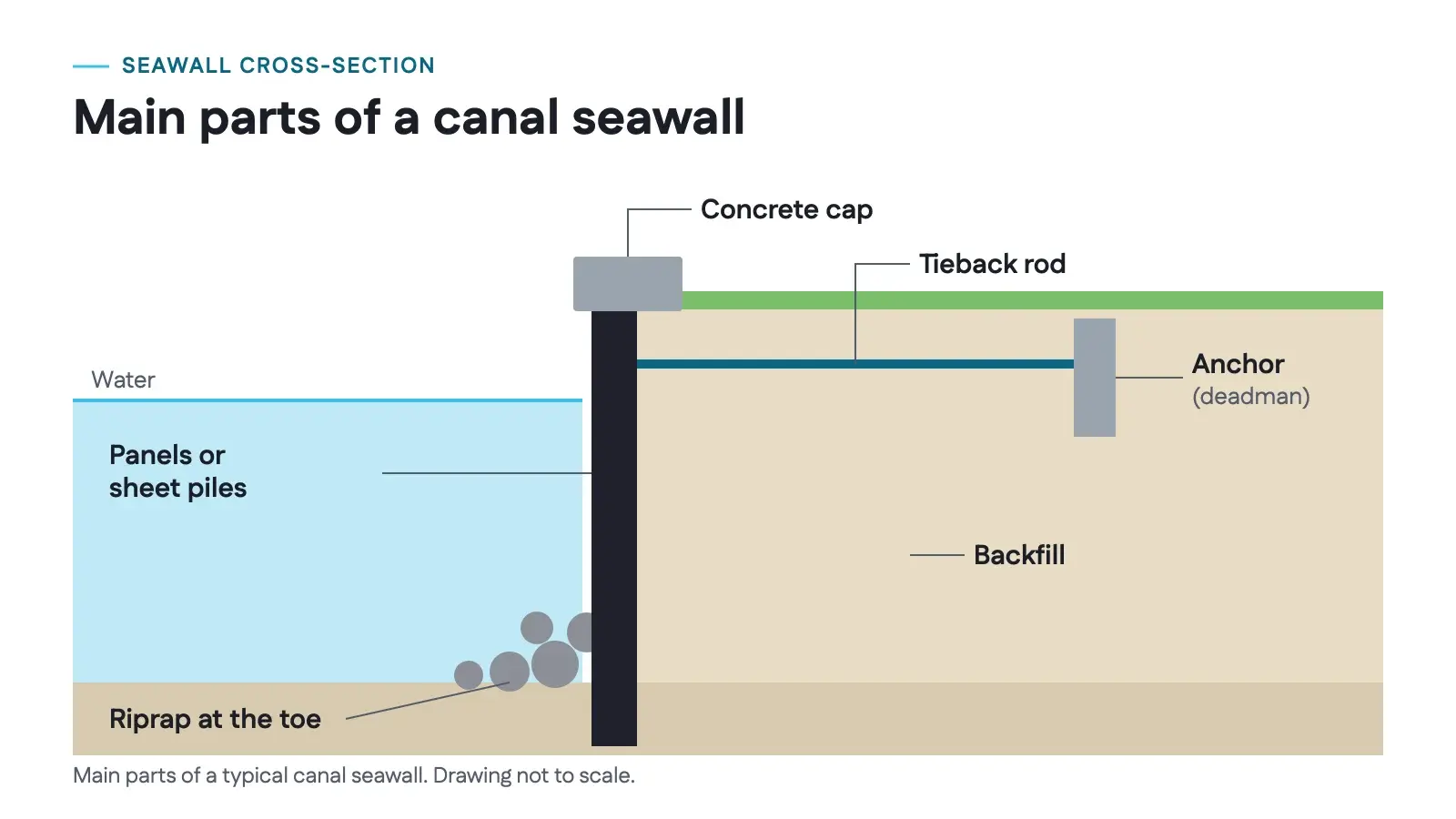
The drawing below shows the main parts of a typical canal seawall. The face is a row of vertical panels, called sheet piles. A cap runs along the top. A tieback rod ties the wall to an anchor buried in the yard, often called a deadman. Backfill is the soil packed behind the wall, and riprap, a layer of large rock, sits at the toe, the base of the wall on the water side.
The table puts the national guide from April 2023 next to the 2026 Florida guide.
One vinyl sheet piling manufacturer offers a 50-year warranty on its product. That is the maker's own promise about its panels.
Wood suits freshwater bulkheads best, since it rots faster in saltwater, and the Florida guide lists vinyl, composite, concrete and steel.
Height can decide the material. The national guide says vinyl walls reach about 6 to 7 feet, and taller walls require concrete or steel. In the same guide, the steel price depends on depth and thickness.
What else goes into a seawall quote besides the wall?
A seawall quote usually adds removal of the old wall, engineering and permit fees on top of the wall itself, and the lines below show what each one costs.
The national guide, updated in April 2023, prices removal of an old wall at $50 to $150 per linear foot, depending on the material and location. Structural engineering plans for the permit cost $2,000 to $3,000 from a certified marine engineer. Permits themselves average $100 to $400.
A Florida real estate guide from September 2026 adds that in coastal zones permit fees, engineering and soil testing are often quoted separately and can add $1,000 to $3,000 or more. Quotes often list these lines separately, so ask each bidder what sits inside the wall price and what comes on top.
Here is a worked example for a vinyl replacement on a 100-foot canal lot, using the Florida vinyl range of $400 to $650 per foot:
Soil testing, riprap and any extra height are outside that total. For a 150-foot lot, the vinyl wall alone comes to $60,000 to $97,500 before demolition, engineering and permits.
For comparison, the 2026 Florida marine contractor guide says a typical 100-foot seawall may cost about $40,000 to $100,000 or more. It names material, wall height, soil and water conditions, engineering, permits, demolition, drainage and site access as the factors behind that spread.
How tall does a new seawall have to be in Broward and Miami Beach?
In Broward County, a new seawall, or one that gets a substantial repair, must reach 5 feet NAVD88, with 4 feet allowed for applications filed before 2035. Miami Beach requires 5.7 feet NAVD88, or 4 feet for a wall built to be raised later.
NAVD88 is a vertical reference for measuring elevation. A wall top at 5 feet NAVD88 sits 5 feet above that reference. How far that is above your yard depends on the ground level of your lot, so ask your surveyor for the current elevation of your wall cap.
According to Broward County Code Section 39-407, adopted as Ordinance 2020-11 on March 31, 2020, every new or substantially repaired seawall (substantial repair is defined in the next section) must work as a tidal flood barrier with a minimum elevation of 5 feet NAVD88. Applications filed before January 1, 2035 may be permitted at 4 feet NAVD88 if the wall is designed to reach 5 feet NAVD88 by January 1, 2050.
Miami Beach adopted its seawall ordinance on January 13, 2021. According to the city, all new seawalls there must reach 5.7 feet NAVD88, or 4 feet NAVD88 if designed to support a future elevation of 5.7 feet.
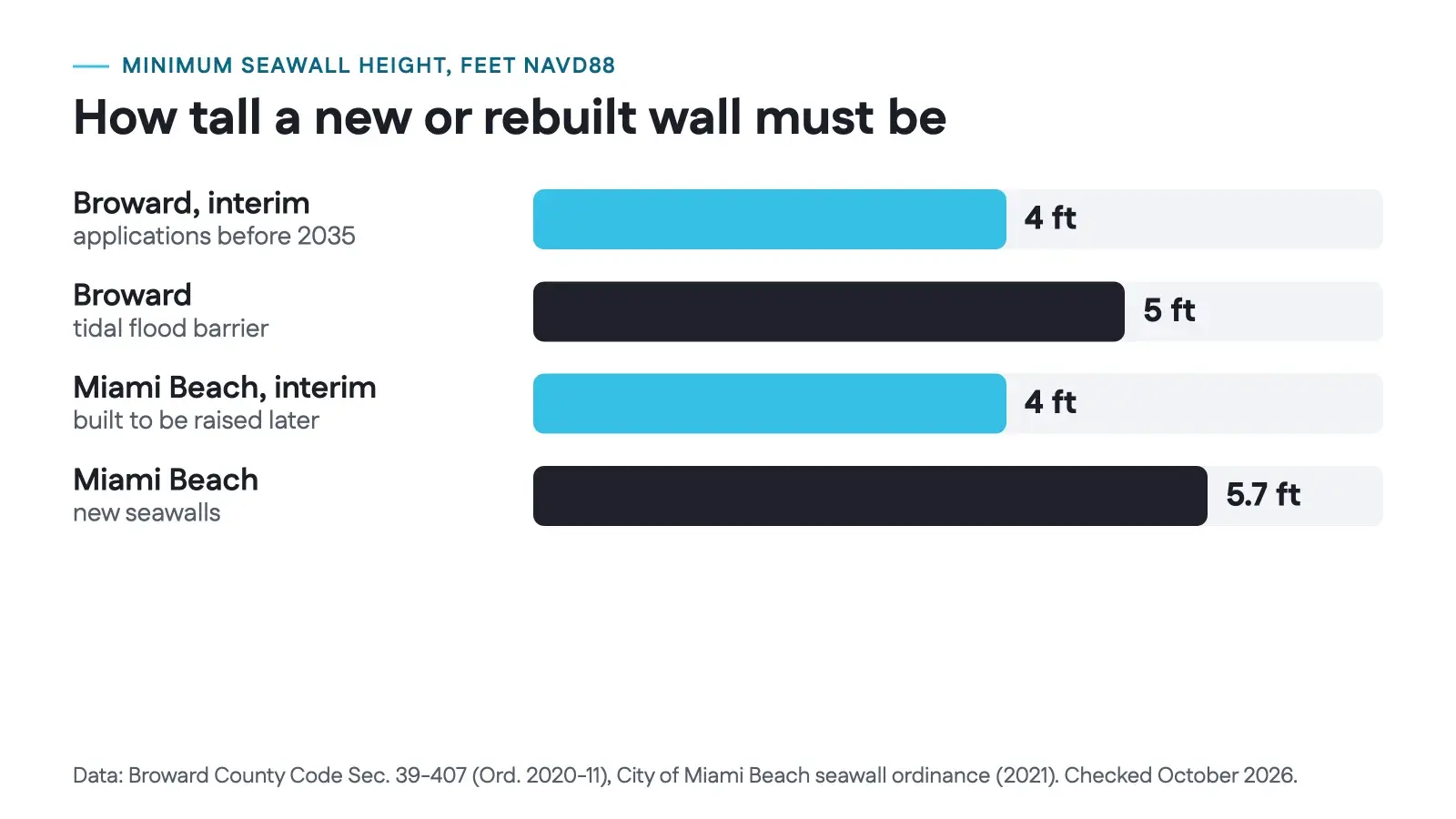
The cost guides cited here give no separate price for extra height, so ask each bidder to price the wall twice, once at the elevation your wall has now and once at the minimum your city requires. The gap between the two numbers is what the rule costs on your lot. If the required wall grows past the vinyl limit noted in the materials section, the bid moves to concrete or steel. For the house side of a waterfront lot, see the guide on storm resistant houses.
Other cities and counties set their own rules. If your lot is elsewhere in Miami-Dade or in Palm Beach County, ask your city or county building office three things before you price the wall: the minimum top elevation in feet NAVD88, if any, the repair threshold that counts as a rebuild, and the deadline to fix a wall that water flows over.
When does a seawall repair force you to rebuild to the new height?
In Broward, work along more than half of the shoreline counts as substantial repair, and the whole wall must then meet the barrier standard. In Miami Beach, repairs of $500 or more per linear foot do the same.
Broward County Code defines substantial repair as any modification along more than 50 percent of the length of the property shoreline. Once that threshold is met, the new wall must run along the whole shoreline of the property. The same rule applies when fixed infrastructure such as a mooring structure is attached to a seawall.
According to the city, Miami Beach raised its threshold in a June 25, 2025 amendment. Repairs costing $500 or more per linear foot now count as substantial improvements that must meet the minimum elevation, up from $300 before the change.
Two examples apply these thresholds to real lot lengths:
- A Broward lot with 80 feet of shoreline: modifying more than 40 feet counts as substantial repair, and the whole shoreline then comes up to the tidal barrier standard.
- A 100-foot Miami Beach seawall: repairs costing $50,000 or more cross the substantial improvement line and trigger the 5.7 feet NAVD88 elevation.
Run the same math on your own shoreline before you approve a repair quote.
Miami Beach also has a proposal on the table. An amendment presented at first reading on June 24, 2026 would extend the compliance period, the time an owner has to fix a wall that water spills over, from two to five years when the water reaches only the owner's own property. Until the city adopts it, plan on the current two years.
When is a seawall repair enough, and when do you replace it?
Small repairs fit a damaged cap, loose tiebacks or open joints, while a leaning wall or washed out soil at the base usually calls for replacement.
The national guide, updated in April 2023, sorts the damage into two groups:
- Non-structural repairs such as cap cracks, new caps and tiebacks, joint grouting and soil stabilization cost $100 to $250 per linear foot.
- Leaning walls, joints pulling apart, washed out soil at the toe and cracked panels at the waterline usually mean replacement, which the same guide prices at $150 to $600 per linear foot.
If your wall leans, start with a replacement quote and price the repair second.
Broward adds a legal test. Under the county code, a seawall is presumed to be in disrepair if tidal water flows through or over it onto neighboring land or the street. After a citation, the owner must show progress within 60 days and complete repairs within 365 days.
Small repairs in the national guide stay below the Miami Beach line of $500 per foot (see the previous section), but the city measures the cost of your actual repair. Ask the city whether your repair crosses it before you choose between repair and replacement.
Which permits does a seawall need in Miami-Dade and Florida?
Seawall work can involve a state, a county and a federal approval. Florida law exempts some restorations from the state environmental permit under set conditions, and the county handles its own permit.
- Check the state exemption. Florida Statutes section 403.813 lets you restore a seawall at its old location, behind it, or up to 18 inches out toward the water without a state environmental resource permit. The state rule measures the 18 inches from the face of the existing wall.
- Read the conditions. The exemption covers a wall damaged or destroyed within the last year by a storm, flood, accident or fire, or work that needs only minimal backfill. Support piles or a new cap added only to repair a wall are also exempt if they do not block boat traffic. Coastal construction permitting under chapter 161 still applies.
- Apply at the county. In Miami-Dade, a 2022 county memo says a new or replacement wall within 12 inches of the existing one can use a short form Class I permit from the county. A wall set more than 12 inches out must go to the County Commission. That memo is from 2022, so call the county to confirm the current steps.
- Ask about the federal layer. According to Florida DEP, the Army Corps Jacksonville District issued the expanded State Programmatic General Permit SPGP VI on July 27, 2021, which cut the need for separate Corps approval of minor shoreline stabilization in Florida waters. Ask the Corps whether it covers your project today.
A state exemption removes one approval and leaves the local height rule in place. In Broward, a wall rebuilt without a state permit still has to reach 5 feet NAVD88 when the repair counts as substantial (see the section on repairs).
The exact wording is in the state exemption in Florida Statutes and on the Florida DEP page on federal permits.
Do riprap or a living shoreline work on a seawall lot?
In the national guide, riprap costs less per foot than a new wall, and NOAA says living shorelines tend to cost less to install and maintain than hardened shorelines. Both can sit in front of a wall or along an open shore.
Riprap, the rock layer described at the toe of the wall above, can also stand alone as a rock or boulder revetment along a shore. The national guide prices it at $50 to $200 per linear foot, against $150 to $600 for a new wall, and a living shoreline of marsh grasses, oyster shell or granite rock at $50 to $350.
NOAA describes a living shoreline as a nature-based way to stabilize a shore with plants, sand, rock or oyster shells. Concrete seawalls and bulkheads are the hardened option. NOAA also reports that 15 feet of marsh can absorb 50 percent of incoming wave energy, and a Florida DEP flyer says most small living shoreline projects in Florida qualify for a state permit exemption.
Under the Broward code, every tidal flood barrier needs natural limerock riprap or another approved habitat enhancement at its water side, so riprap often appears in the quote next to the wall. Ask an engineer whether a living shoreline fits your lot.
Seawall quote mistakes to avoid before you sign
Before signing, check that the quote names the wall height in feet NAVD88, lists demolition, engineering and permits as separate lines, and says how much of the shoreline the work touches.
Use this checklist when you compare bids:
- Does the quote state the top elevation of the wall in feet NAVD88, and does it meet the minimum for your city or county? See the section on Broward and Miami Beach.
- Are demolition, engineering and permits separate lines, so two bids compare on the same basis? See the worked example.
- Does the quote say how much of the shoreline the work covers, measured against the repair triggers above?
- Is the per foot price tied to a named material, height and anchoring design?
- How old is the price you budgeted with? See the dates in the first table.
- Does the bid name a certified marine specialty contractor? See the FAQ below.
How a seawall fits into a waterfront home project
A seawall height requirement and its permits are part of the site conditions for a waterfront house, so it helps to know them before the house budget is set.
Florida Home Build lists waterfront construction, including homes and docks, among its work as part of larger turnkey projects in Miami-Dade, Broward and Palm Beach counties, and handles city and county permits and inspections. Small standalone jobs are generally outside its focus. It does not publish seawall prices, and the ranges in this article come from published guides. If you are planning waterfront construction in Miami, ask about the seawall elevation at the first site meeting. You can also read what a new Florida house costs to set the house budget next to the wall budget.
Frequently asked questions
Do I need a state permit to fill a gap between two seawalls?
Often no. Under Florida Statutes section 403.813, a private seawall that fills a gap between existing seawalls on both ends is exempt from a state permit if it follows their line and is no more than 150 feet long. County permits and any local height requirement still apply, so check them before work starts.
Can I attach a dock to an old seawall in Broward?
It depends on the wall. Under the Broward rule explained above, fixed infrastructure such as a mooring structure attached to a seawall counts toward substantial repair, so the old wall may first need to reach 5 feet NAVD88. Ask the county how the rule applies to your wall before you design the dock.
Who can build a seawall in Florida?
Florida certifies marine specialty contractors to build, repair and alter seawalls, bulkheads, docks and other marine structures under Florida Administrative Code Rule 61G4-15.100. Ask each bidder for the certification number and look it up with the state licensing board before you sign a contract for the wall.
How often should a seawall be inspected?
Every 5 to 6 years and at the time of a sale, according to the national cost guide, which says a marine structural engineer should do the check. Put the next inspection on your calendar when you buy a waterfront home, and ask for a written report you can show a future buyer.
Do I have to disclose seawall rules when selling a house in Broward?
Yes, for property on tidal water. Since December 31, 2020, sale contracts for property in tidally influenced areas of Broward must disclose that the owner may be required to meet tidal flood barrier elevation standards. Sellers and buyers can ask a real estate attorney how the clause applies to their sale.
30.10.2026