
How Much Do General Contractors Charge per Hour in Florida?
How much general contractors charge per hour comes to about $50 to $150, according to a national consumer cost guide. On a large project, cost guides put the usual fee at 10 to 20 percent of construction cost. National data from the National Association of Home Builders (NAHB) put builder overhead and profit at 16.7 percent of a new home's price.
This guide is for owners of a lot in Miami-Dade, Broward or Palm Beach who are planning a premium custom home. It sets the cost-guide figures next to NAHB and Miami wage data, shows how the fee behaves under each contract and lists what to check in a bid.
How much do general contractors charge per hour?
HomeGuide, a national consumer cost guide, puts general contractors at about $50 to $150 an hour. Hourly billing is rare on a full build and is mostly used for small jobs and pre-construction planning.
HomeGuide adds that contractors rarely charge by the hour except for pre-construction planning or small projects. Pre-construction planning is the early work of pricing a job and settling its scope before building starts.
An hourly rate says nothing about the total. To turn it into a project price you would need the number of hours, and a bid for a whole house states the total.
Use the hourly range to ask questions, and check what each rate includes before you compare it with another.
How much do general contractors charge per project instead of per hour?
Cost guides put the usual general contractor fee at 10 to 20 percent of construction cost, and Thumbtack quotes up to 30 percent. The guides give typical ranges.
The table shows what each consumer guide says and what its number applies to. All three are cost guides, a weaker source than a statute or a survey, so read them as typical ranges.
Overhead means the costs of running a contracting business that are not billed to one job, such as insurance and the office. Profit is what the contractor keeps after all costs.
HomeGuide gives a worked example for building a house. For a project of $178,000 to $416,000 it estimates the general contractor fee at $18,000 to $83,000, which it says covers overhead, profit and a markup on materials and labor. The two ends of that range sit close to the guide's own 10 to 20 percent.
The word markup in Thumbtack's guide and fee in the others may describe different things, so ask each contractor what its number is applied to. Treat 10 to 20 percent of construction cost as a rough reference point: a quote well outside it is a reason to ask what the number covers.
How much of a new home's price goes to the builder's overhead and profit?
In NAHB's 2024 national survey, builder overhead was 5.7 percent of an average new home's price and profit 11.0 percent. Together that is 16.7 percent, or about 26 percent on top of the construction cost.
NAHB is the National Association of Home Builders. In its 2024 survey the average sales price of a new single-family home was $665,298, for a home of 2,647 square feet on a lot of 20,907 square feet.
Construction cost was 64.4 percent of that price, or $428,215, and the finished lot was 13.7 percent, or $91,057. Overhead and general expenses averaged $38,248, and builder profit averaged $72,971, or 11.0 percent of the price, up from 10.1 percent in 2022. Sales commission took 2.8 percent, financing cost 1.5 percent and marketing 0.8 percent.
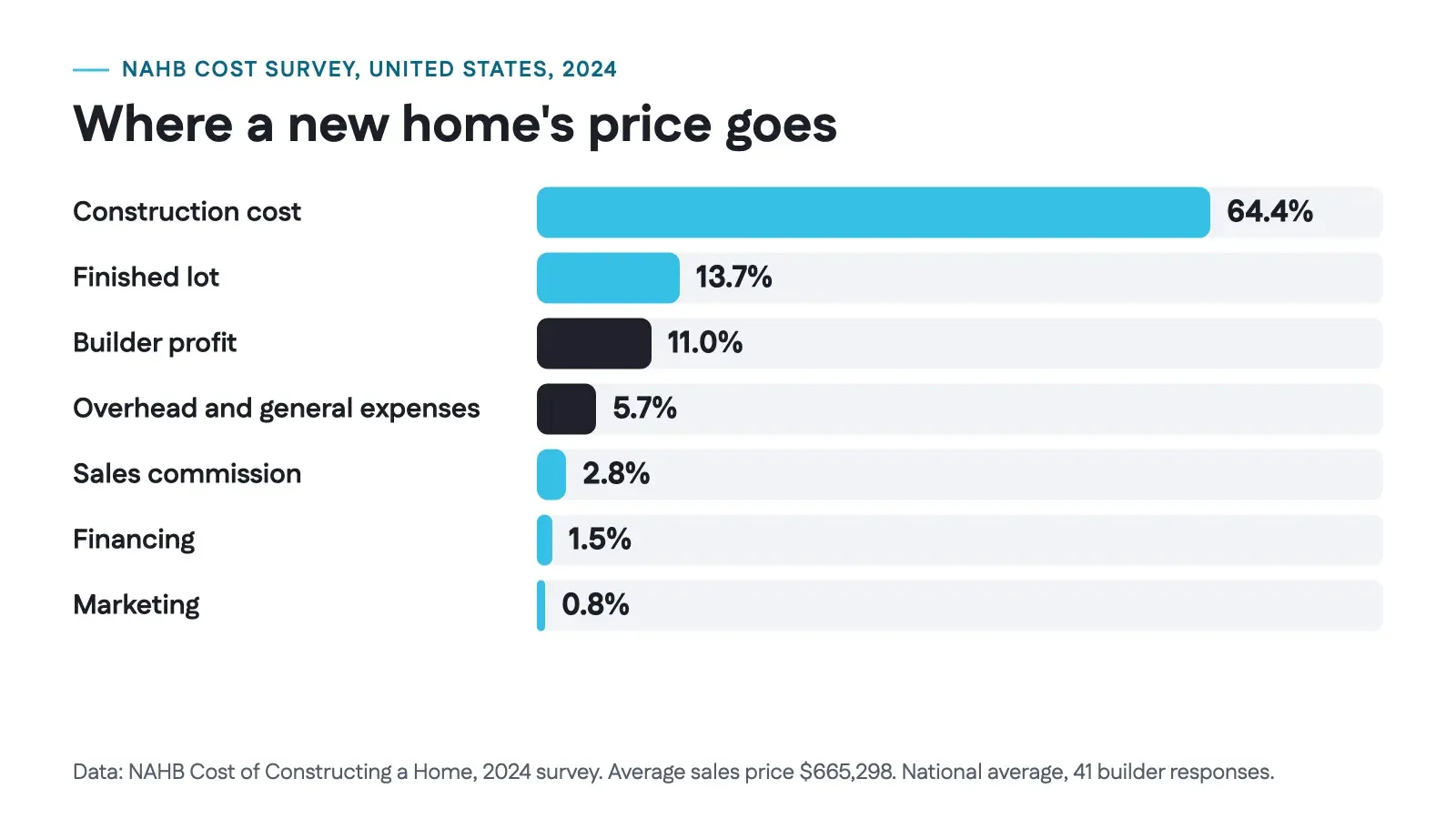
NAHB's construction cost category includes labor paid directly by the general contractor, subcontractors and materials. The cost guides apply their percentages to construction cost.
Overhead and profit together came to $111,219. The same dollars are 16.7 percent of the sales price and about 26 percent of the construction cost. A guide's 10 to 20 percent of construction cost therefore cannot be set directly against NAHB's 16.7 percent of price. The guides quote a contractor's fee, while NAHB reports what builders who sell homes spend on overhead and keep as profit.
The sample matters too. The survey is a national average from 41 usable builder responses, out of 4,000 builders emailed. It has no breakdown by region and is not a representative sample of the homes built in a year. Do not read it as a figure for South Florida.
For comparison, NAHB's Remodelers' Cost of Doing Business Study for fiscal year 2024 was published in April 2026. Residential remodelers averaged a 29.9 percent gross profit margin and a 6.3 percent net profit margin. The net margin was the highest since 1996. Gross margin is the share of revenue left after the direct costs of the job, and net margin is what remains after all expenses. Remodelers run a different business from new-home builders, so use these numbers only for scale.
What does a general contractor's fee cover?
The fee pays for the contractor's overhead and other costs not billed directly, plus profit. In Florida some of that overhead is required by law, from liability insurance to workers' compensation for even one employee.
The American Institute of Architects (AIA) describes the fee in a cost-plus contract as generally covering overhead and other costs not compensated directly. The Florida items that sit inside it are these:
- Liability insurance. A certified general contractor must carry at least $300,000 in public liability and $50,000 in property damage insurance under Florida Administrative Code rule 61G4-15.003. A contractor who lets that cover lapse violates the rule.
- Workers' compensation. In Florida's construction industry it applies to every private employer with one or more employees. In other industries the threshold is four or more.
- Subcontractor coverage. If a contractor sublets work to a subcontractor who has no workers' compensation, the contractor must provide it for that subcontractor's employees. The law also requires the contractor to ask each subcontractor for evidence of coverage.
Bids can place the costs of running the job site, such as the superintendent and temporary facilities, in different lines. A separate line for them is often called general conditions. Ask each contractor where those costs sit before you compare fees.
How does a contractor's hourly rate compare with Miami construction wages?
In May 2025 construction managers in the Miami metro area earned a median $60.63 an hour, about 10 percent above the national $55.28. That is a wage paid to an employee, a different figure from the rate a contractor bills.
The Bureau of Labor Statistics (BLS) notes that construction managers are often called general contractors or project managers. For the Miami-Fort Lauderdale-West Palm Beach metro area, BLS reports a median of $126,110 a year for the role. The national median is $114,990 a year. Statewide in Florida the median was $54.39 an hour, or $113,130 a year, so the Miami figure is about 11 percent above the state's.
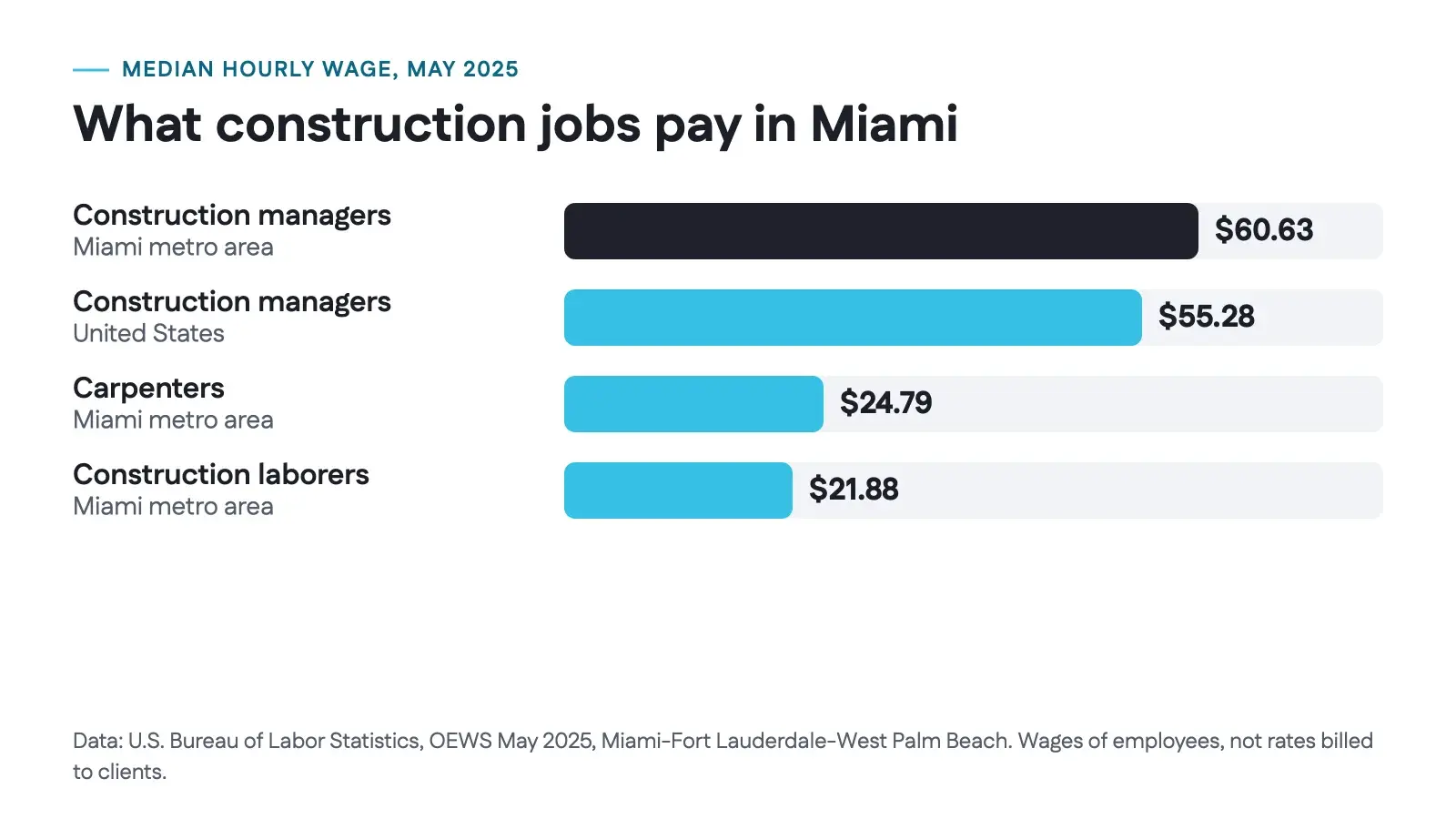
Carpenters and laborers earn well below that. In the Miami metro area carpenters earned a median of $24.79 an hour and construction laborers $21.88 in May 2025.
BLS wage estimates do not cover the self-employed or owners and partners in unincorporated firms. About 38 percent of construction managers in the United States are self-employed. The BLS figures therefore describe mostly employees on a payroll, and they say little about the earnings or fees of a contractor who owns the company. A contractor who bills a client also has to cover the overhead and profit described above.
How do general contractors get paid on a new home?
Under a cost-plus contract, a percentage fee grows with every dollar of cost, while a fixed fee stays the same. A guaranteed maximum price caps what the owner pays, and a fixed price sets the total in advance.
Cost-plus means the owner pays the cost of the work, which is what the contractor spends on subcontractors, labor and materials, plus an agreed fee. The standard forms come from the AIA, and the table shows how the contractor's own fee behaves in each model when costs rise.
AIA A101-2017 is the standard owner-contractor agreement for a stipulated sum, suited to work where the cost is set in advance by bidding or negotiation. In A102-2017 and A103-2017 the fee can be a lump sum, a percentage of the cost of the work, or another agreed method.
AIA A103-2017 covers cost of the work plus a fee without a guaranteed maximum price. It is meant for large projects where the cost is not fully known when construction starts, and not for competitive bidding. For custom residential projects AIA offers A110-2021, which can be priced as a stipulated sum or as cost of the work plus a fee, with or without a guaranteed maximum price.
Which model fits depends on how much of the house is defined at signing. Read more about contract types and the final price before you choose.
How do you compare general contractor bids in Florida?
Compare bids on the same scope and ask each contractor what the fee is calculated on, what sits in general conditions and how changes will be priced. Then check the license and insurance before you sign.

Use this checklist with every bid:
- Same scope. Give every contractor the same drawings and the same list of inclusions, and mark what each bid leaves out. A lower total can mean a smaller scope.
- What the fee is calculated on. Ask whether it is a percentage and of what, or a fixed amount. The NAHB section above shows that a guide's percentage of construction cost and NAHB's percentage of price are measured against different totals.
- General conditions or fee. Ask where the superintendent, insurance and temporary facilities sit. Put each bid's costs into the same lines before you compare totals.
- How changes are priced. Under AIA A201-2017, section 7.3.8, when a change adds and removes related work, the contractor's overhead and profit on the change is figured only on the net increase. Ask whether the contract follows that rule. A change can also move the calendar, as covered in how changes affect the schedule.
- Allowances. An allowance is an amount carried in a bid for items not yet chosen, such as fixtures. Ask what each allowance covers and who pays when the final choice costs more.
- License. Look the contractor up on the Florida Department of Business and Professional Regulation portal at myfloridalicense.com, by name, license number, city or county, or license type.
- Insurance. Ask for the liability insurance certificate and proof of workers' compensation. The minimums are in the fee section above.
If two bids differ by a large amount, go back to items 1 to 3 first. Gaps there can come from scope and from where costs are listed.
What do you risk by hiring an unlicensed contractor to save on the fee?
In Florida an unlicensed contractor cannot enforce the contract, and unlicensed contracting is a crime. The state recovery fund for homeowners pays only up to set limits.
Florida Statutes s. 489.105(3)(a) defines a general contractor as a contractor whose services are unlimited as to the type of work. A person who acts as one without a license faces these consequences:
- The contract. Under s. 489.128 the unlicensed contractor cannot enforce the contract in court, and under s. 489.128(2) it has no right to a lien, a legal right against the property, or to a bond for the work.
- Criminal penalties. Under s. 489.127(2)(a), acting as a contractor without a license is a first-degree misdemeanor for a first offense. A repeat violation, or one during a governor-declared state of emergency, is a third-degree felony.
- Stop-work orders. Under s. 489.127(3), the Department of Business and Professional Regulation may issue a stop-work order for all unlicensed work on a project.
- The recovery fund. The Florida Homeowners' Construction Recovery Fund has payout limits. General contractors are in Division I, and for Division I contracts signed on or after July 1, 2024, it pays at most $100,000 per claim against the fund. Its total payout per Division I licensee is capped at $2 million.
If you are weighing the option of acting as your own contractor, the owner-builder checklist covers that route.
How does Florida Home Build charge for a custom home?
Florida Home Build charges a fixed fee under a guaranteed maximum price, so its fee does not grow when costs inside the contracted scope rise. The owner sees every subcontractor bid, change and invoice in a shared tracker.
The cap works as the payment table above shows, and the company is paid in four installments tied to approved stages.
Owners get a client portal, and the site superintendent confirms the next steps every week. The company works as one general contractor with permanent subcontractors and handles city and county permits and inspections for the owner. Your next step is to get written bids on the same drawings from two or three contractors and run each through the checklist above. For a lot in Miami-Dade, Broward or Palm Beach, the company offers general contractor services in greater Miami on this fixed-fee model.
Frequently asked questions
Is $50 an hour reasonable for a contractor?
It sits at the bottom of the range that cost guides give. Ask what a rate that low includes, for example license, insurance and overhead. For comparison, carpenters in the Miami metro area earned a median $24.79 an hour as employees in May 2025.
What is the average pay for a general contractor in Florida?
Statewide, construction managers had a median wage of $54.39 an hour, or $113,130 a year, in May 2025, according to BLS. BLS notes that they are often called general contractors. The figure leaves out self-employed owners, so it says little about what a contractor bills. The Miami figure is higher, as the wage section shows.
Do general contractors charge sales tax in Florida?
Generally no, under a cost-plus contract. Florida rule 12A-1.051 treats cost-plus contracts, whether the fee is fixed or a percentage of costs, as real property contracts. The contractor pays sales tax to suppliers on materials and charges none to the customer. A retail sale plus installation contract is the exception.
How much deposit can a Florida contractor ask for?
Florida law ties deadlines to the size of the first payment. A contractor who takes an initial payment of more than 10 percent of the contract price for residential construction must apply for permits within 30 days. Work must then start within 90 days after permits are issued. The exceptions and other rules that protect your money are in Florida laws that protect your money.
27.10.2026