
How Much Does a Whole House Renovation Cost in Miami and South Florida?
Whole house renovation cost ranges from $15 to $150 per square foot nationally, according to NerdWallet, and from $100 to $250 or more in the Miami area, according to Sweeten. In a flood zone, work that costs at least half of the building's market value triggers current flood rules, which can change the budget.
This article is for owners and buyers of older houses in Miami-Dade, Broward and Palm Beach counties who plan a whole-house renovation. It sets the cost ranges next to the Florida rules that can raise a budget.
How much does a whole house renovation cost?
Cost guides put a whole house renovation at $15 to $150 per square foot nationally and $100 to $250 or more in the Miami area. NerdWallet puts a gut renovation down to the studs at $100,000 to $300,000.
The ranges come from different guides and scopes, so the national and Miami figures cannot be compared directly. The next section compares the same projects in both places.
Multiplied by house size, the ranges give the totals below. This is arithmetic on the guide ranges and on one builder's most common turnkey range, and it is no substitute for a bid.
Guides use the words renovation and remodeling for related work. The difference between renovation and remodeling matters when you compare quotes, because two bids with the same total can cover different work.
Is a whole house renovation more expensive in Miami?
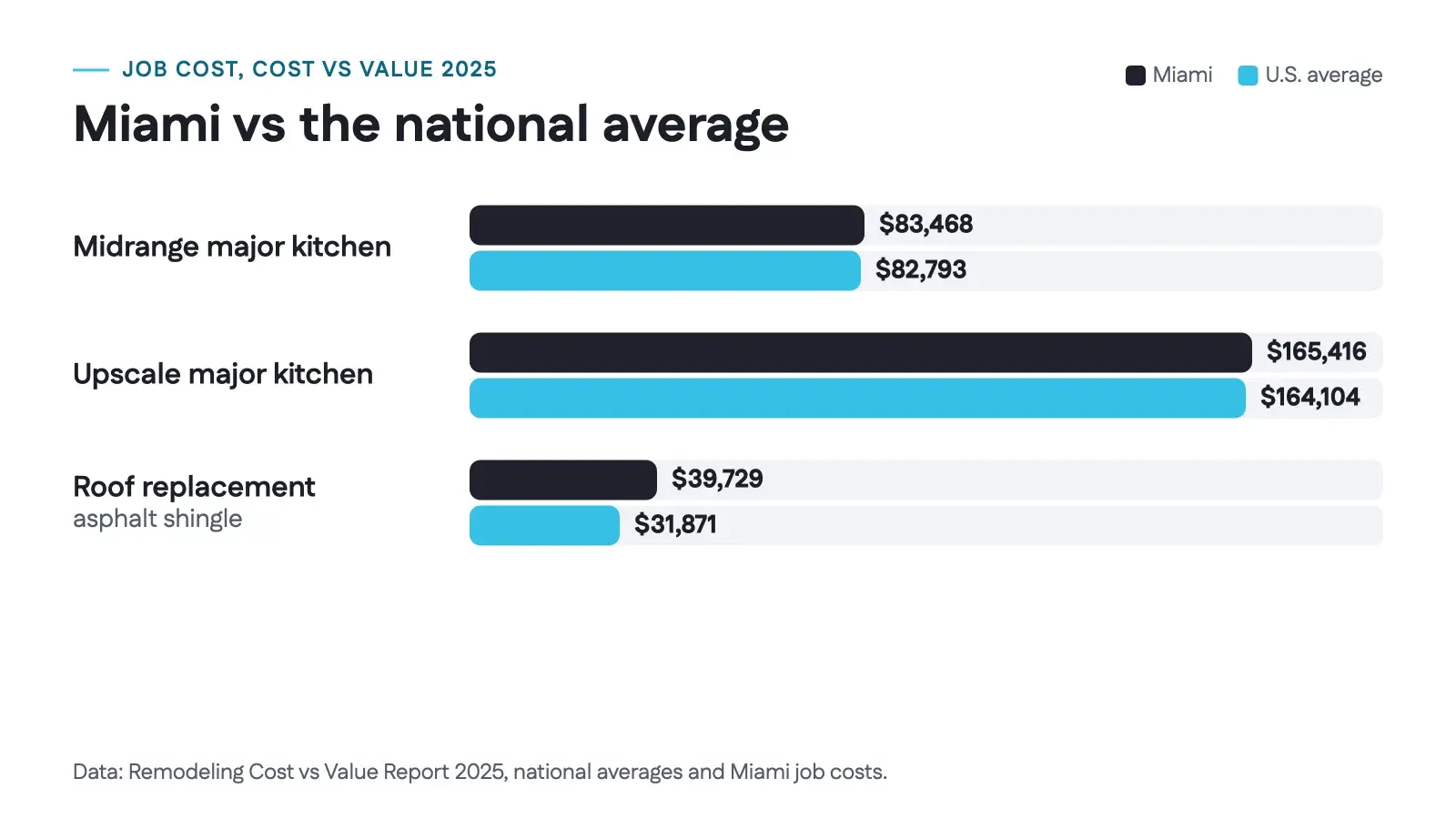
For the kitchen and bathroom projects in the 2025 Cost vs. Value report, Miami is close to the national average, and for the roof it is noticeably higher. A shingle roof replacement cost $39,729 in Miami against $31,871 nationally.
Cost vs. Value lists the job cost of the same project in each market, so a Miami figure and a national figure describe the same scope of work. The report prices single projects and does not price a whole house.
A midrange major kitchen remodel cost $83,468 in Miami against $82,793 nationally, and an upscale one $165,416 against $164,104. Bathrooms in the Miami-Fort Lauderdale table come in slightly lower: a midrange bath remodel cost $25,565 against $26,138, and an upscale one $79,971 against $81,612.
RemodelerIQ estimates a 1,500 square foot whole-house remodel in Miami at $151,394 to $403,718, with a typical figure of $269,145. Its Miami figures apply a +22 percent multiplier to national benchmarks, and its listed data sources include no collected Miami bids. That makes it a modeled estimate, weaker than the Cost vs. Value job costs.
How much do a kitchen and a bathroom cost by finish level?
Kitchen and bathroom costs rise steeply with the finish level. Nationally an upscale major kitchen remodel averaged $164,104 in 2025, about twice a midrange one, and an upscale bathroom $81,612, about three times a midrange one at $26,138.
These figures price one room each. The sources here do not split a whole house budget by room, so treat them as anchors for the rooms you plan to change.
What is the 50 percent rule, and how can it change a renovation budget?
If the cost of a renovation equals or exceeds 50 percent of the building's market value, the house counts as substantially improved. In a flood zone it must then meet current flood rules, which can mean raising the lowest floor.
The rule comes from the National Flood Insurance Program (NFIP). Under 44 CFR 59.1, a substantial improvement is any reconstruction, rehabilitation, addition or other improvement whose cost equals or exceeds 50 percent of the structure's market value before construction starts. Market value here means the value of the building alone. FEMA's guidance leaves out the land, landscaping, the driveway and detached accessory structures.
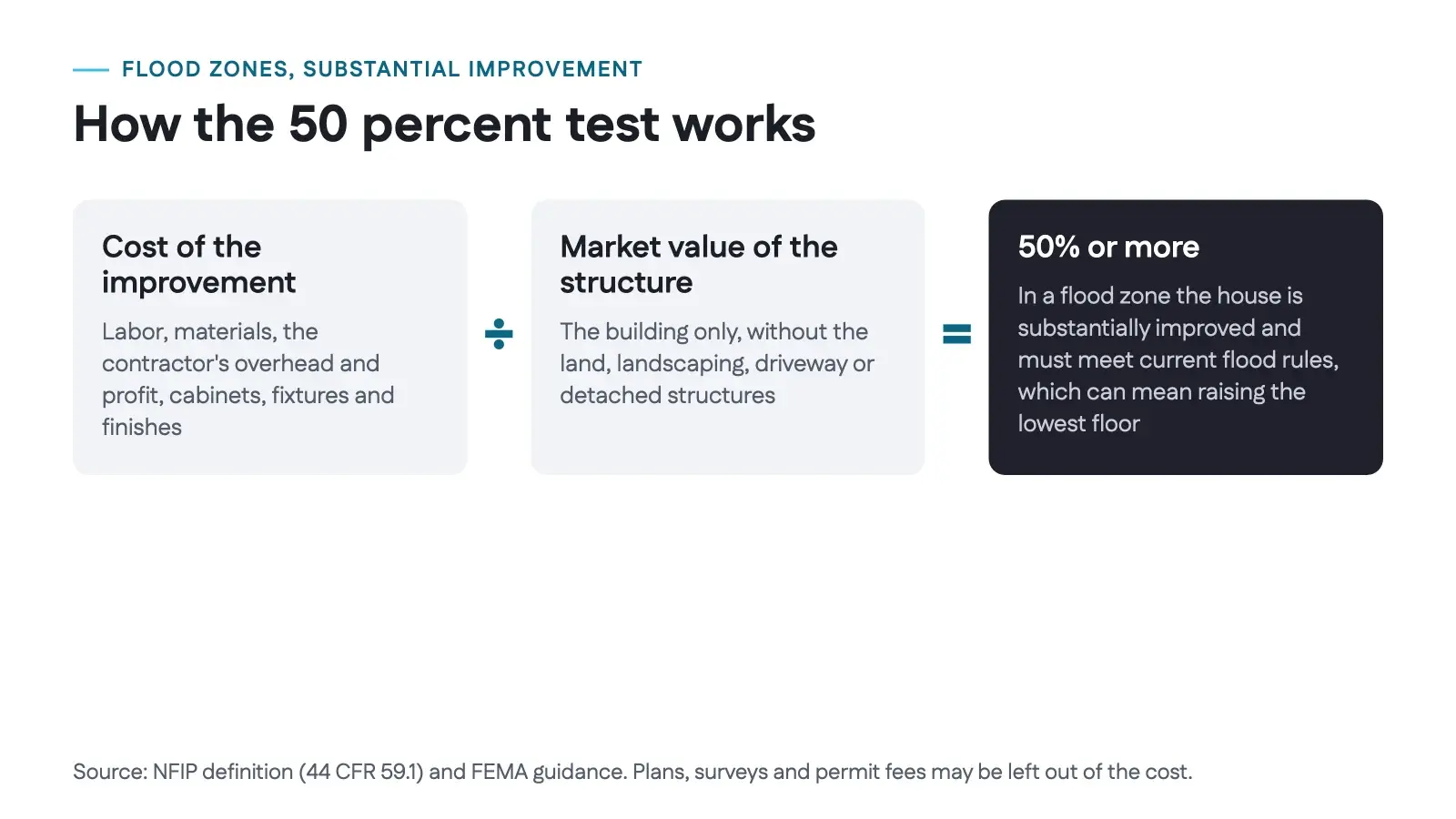
FEMA says the estimate must include all labor and materials and, when a contractor does the work, the contractor's overhead and profit. Its desk reference also counts construction management, sales tax on materials, kitchen and bathroom cabinets, bathroom tiling and fixtures, and floor and wall finishes. FEMA allows plans and specifications, land survey costs, and permit and inspection fees to be left out.
Two kinds of work fall outside the rule. One is a project that only corrects health, sanitary or safety code violations the code official has cited, and does no more than safe living conditions require. The other is an alteration of a historic structure that keeps its historic designation.
What compliance means depends on the flood zone and the community. In the high-risk flood zones A1-30, AE and AH, federal rules require communities to have the lowest floor of a substantially improved house at or above the base flood elevation. That is the flood level shown for the site on flood maps.
The City of Miami Beach says that once a structure is substantially improved, every aspect must be made compliant. That may include elevating the structure, using flood resistant materials and installing flood venting. In Palm Beach County outside city limits, substantial improvements in zones AE, AH and VE (the coastal high-hazard zone) must have the lowest floor at least one foot above the base flood elevation. The rule also covers air conditioning, plumbing fixtures and ducts. The county estimates the building's market value, or requires an independent appraisal, for every permit application that involves improvements.
One state statute is narrower. Section 161.54(12) of the Florida Statutes leaves nonstructural interior finishings such as cabinets, tile, drywall, fixtures, appliances and roof coverings out of the cost. It applies when the state judges whether a single improvement or repair is substantial. It applies only to coastal construction near the shoreline and the coastal construction control line. For the general 50 percent test, FEMA counts these finishes.
Before you sign a contract, find out whether the house sits in a flood zone and how the building department will value it. Ask for a written scope that names any flood, roof or opening protection work. If the rule applies to your house, compare the budget with the cost to build a new house.
Can you avoid the 50 percent rule by spreading the work over several years?
Since June 26, 2025, Florida law bars local governments in the flood insurance program from adding up improvements over several years. Each permit application is now measured on its own.
The law is section 163.31795 of the Florida Statutes. It bars any county or city in the NFIP from adopting or enforcing a substantial improvement rule that adds up improvements or repairs over a lookback period. FEMA's minimum NFIP rule applies the 50 percent test to each separate application, and the cumulative option used to be a local choice.
Several South Florida cities used that choice before the law. Miami Beach counted all building permits from the last year, the City of Miami counted two years under a 2021 policy, and a 2015 Doral form counted five years. Some of these city pages and forms still describe the old rules.
Splitting one project is a different matter. The City of Cedar Key, outside South Florida, warns that splitting a project into several permits to evade the rule is prohibited and can lead to permit revocation. The same city FAQ adds that flood insurance underwriting may still consider cumulative improvements when setting rates and coverage. Ask your insurer how it treats several years of work on one house.
How do Florida code alteration levels raise the cost of a large renovation?
The Florida Existing Building code sorts alterations into three levels. Level 3 applies when the reconfigured work area exceeds 50 percent of the building area.
The levels in the 2023 code, 8th edition, are:
- Level 1: removal and replacement or covering of existing materials, elements, equipment or fixtures with new ones that serve the same purpose.
- Level 2: adding or eliminating any door or window, reconfiguring or extending any system, or installing additional equipment, where the work area is 50 percent of the building area or less.
- Level 3: alterations where the work area exceeds 50 percent of the building area.
Work area, in the code's words, is the portion of a building consisting of all reconfigured spaces indicated on the construction documents. This 50 percent measures the area that the plans reconfigure. The 50 percent rule in the previous sections compares cost with the building's market value. A house can pass one test and trip the other, so check both.
Miami-Dade County's Permitting and Inspection Center says the Florida Building Code, Ninth (2026) Edition becomes effective on December 31, 2026. Permit applications and plans submitted in the county on or after that date must comply with it, so check which edition applies on your filing date.
What do windows, doors and the roof add to a renovation in South Florida?
Florida law directs the building code to require opening protection for permitted work estimated at $50,000 or more on a site-built single-family home in the wind-borne debris region. The home must be insured or valued at $750,000 or more. Roof work has its own 25 percent rule.
Opening protection means impact-rated windows and doors or shutters that guard a building against hurricane wind and flying debris. The rule is in section 553.844(3)(c) of the Florida Statutes and covers work applied for on or after July 1, 2008. Roof covering replacement, or repair to prevent degradation, is left out. A house without insurance is measured by its just value, the property appraiser's estimate of market value.
Two roof rules matter in a renovation:
- The 8th edition of the code says not more than 25 percent of the roof area or roof section may be repaired, replaced or recovered in any 12-month period. Above that, the roof covering on the entire roof system or section must be brought up to code.
- A roof built, repaired or replaced to the 2007 Florida Building Code or later has an exception. Section 553.844(5) says that when such a roof is worked on at 25 percent or more, only the repaired, replaced or recovered portion must meet the current code.
The High-Velocity Hurricane Zone in the Florida Building Code consists of Miami-Dade and Broward counties, so Palm Beach County is outside it. Product approvals for windows, doors and roofing are covered in the article on storm resistant houses.
Do you need a permit to renovate a whole house in Florida?
Yes, the Florida Building Code requires a permit to alter or repair a building or to replace impact-resistant coverings or its electrical, gas, mechanical or plumbing systems. An owner can act as their own contractor only under set conditions.
Florida's owner-builder exemption, in section 489.103(7) of the Florida Statutes, covers an owner who supervises the work directly on site. It applies to a one-family or two-family residence for the owner's own occupancy that is not offered for sale or lease. A sale or lease, or an offer, within 1 year after completion creates a presumption that the work was done for sale or lease. The owner-builder checklist walks through the steps an owner takes on.
What changes if the house was built before 1978?
Paid work that disturbs painted surfaces in a home built before 1978 must be done by an EPA-certified firm using lead-safe practices. Small jobs that disturb 6 square feet or less of painted surface per room inside, or 20 square feet or less outside, are exempt.
This is the EPA Renovation, Repair and Painting (RRP) Rule. It requires anyone paid to do such work to be certified and to use lead-safe work practices, with employees trained as certified renovators. The small-job exemption does not apply to window replacement or to demolition of painted surfaces.
Studios with no separate bedroom are excepted from the rule. So is housing for the elderly or people with disabilities, unless a child under 6 lives there or is expected to.
Will a renovation raise your property tax or lower your insurance?
Improvements to a homestead are added to its assessed value at just value on the January 1 after they are finished. Florida law requires home insurance rate filings to include wind mitigation discounts, so new impact windows or roof work can lower the premium.
A homestead is an owner's permanent residence that carries Florida's homestead exemption. The details:
- Property tax. Under section 193.155(4)(a) of the Florida Statutes, improvements to homestead property are assessed at just value as of the first January 1 after they are substantially completed.
- Wind mitigation discounts. Wind mitigation means features that reduce windstorm loss, such as roof strength, roof-to-wall strength and opening protection. Florida law requires residential property insurance rate filings to include discounts, credits or reduced deductibles for them. Insurers must use the uniform inspection form, OIR-B1-1802, revised effective April 1, 2026.
- My Safe Florida Home. The state program offers a free wind mitigation inspection with no obligation to apply for a grant. Grants are matched at $2 from the state for each $1 from the applicant, up to $10,000 from the state. The home must be site-built, owner-occupied and homestead, with an insured value of $700,000 or less, built before January 1, 2008. Since June 2026 the statute also limits grants to low-income or moderate-income owners, and the program depends on annual legislative appropriations.
How does Florida Home Build price a whole house renovation?
Florida Home Build quotes turnkey whole-home renovation at $50 to $250 per square foot, most often $75 to $150. It does not take small jobs, and its request form starts at a budget of about $250,000.
This is the company's stated range, and it is not taken from the guides above. The request form starts at a budget of about $250,000, so the smaller totals in the size table are arithmetic on the range and not a quote from the company.
Your next step is to write down the rooms and systems you plan to change, the year the house was built and whether it sits in a flood zone. Then ask two or three contractors for written scopes on that same list. The company's service page is home renovation in Miami, and the fee side of a contractor's price is explained in how general contractors charge.
Frequently asked questions
How much would it cost to fully renovate a 2,000 square foot house?
At the Miami guide range of $100 to $250 per square foot, a 2,000 square foot house comes to $200,000 to $500,000, and Sweeten's middle figure of $175 gives $350,000. The size table above adds the national range and one builder's range. All of these are arithmetic on published ranges, and a bid for your own house can differ.
Is $100,000 enough to renovate a house?
At the Miami guide range of $100 to $250 per square foot, $100,000 pays for about 400 to 1,000 square feet of whole-house renovation. That is also the low end of NerdWallet's national range for a gut renovation, which runs from $100,000 to $300,000.
Is it cheaper to renovate a house or build a new one?
In a flood zone, a renovation that costs 50 percent of the building's market value or more must meet current flood rules, as the 50 percent section explains. Price both options for your lot, and use the new-build figures in the cost-to-build guide linked in that section as a starting point.
How much does it cost to renovate a condo in Miami?
The company quotes condo renovation at $150 to $350 per square foot, a higher range than its house range. It handles city and county permits, inspections and condo association applications for the owner.
29.10.2026