
Can You Remodel a Condo in Florida? Association Rules and Permits
Yes, you can remodel a condo you own in Florida, as long as the work stays inside your unit and follows your declaration and the association's rules. Electrical, gas, mechanical and plumbing work also needs a building permit. Changes to the parts all owners share follow the declaration's procedure or a 75 percent owner vote.
This guide is for owners and buyers of condo units in Miami-Dade, Broward and Palm Beach counties, including owners who live elsewhere. It shows which sign-offs each kind of work needs, the order to collect them in, what skipping a step costs, and what a full unit renovation takes in time and money.
Can you remodel a condo you own in Florida?
Yes, you can remodel the inside of your own condo unit in Florida. Three layers set the limits: the association's declaration and rules, the building permit office, and the rules on who may do permitted work.
The declaration is the recorded document that creates your condominium and describes what belongs to your unit and what belongs to all owners. Florida's condominium law backs it up. Under section 718.303, every unit owner, tenant and guest must comply with the condominium law, the declaration, the association documents and the bylaws.
Section 718.113(3) adds a safety rule. A unit owner may not do anything inside the unit or on the common elements that would harm the safety or soundness of the common elements.
The second layer is the city or county permit. The third is who may hold that permit: a licensed contractor or, in some cases, the owner.
What part of a condo can you change on your own?
You can change what the declaration treats as your unit. Florida law gives you exclusive ownership of the unit as the declaration describes it. Everything outside the units is a common element, and some common elements, such as a balcony, may be limited common elements reserved for your unit.
Section 718.103 defines all three. A unit is the part of the condominium property subject to exclusive ownership. Common elements are the portions of the property not included in the units. Limited common elements are common elements reserved for certain units, to the exclusion of all others, as the declaration specifies.
The declaration decides where your unit ends. A wall, the slab, a column or a pipe may fall on either side of that line, so read the document before you draw anything.
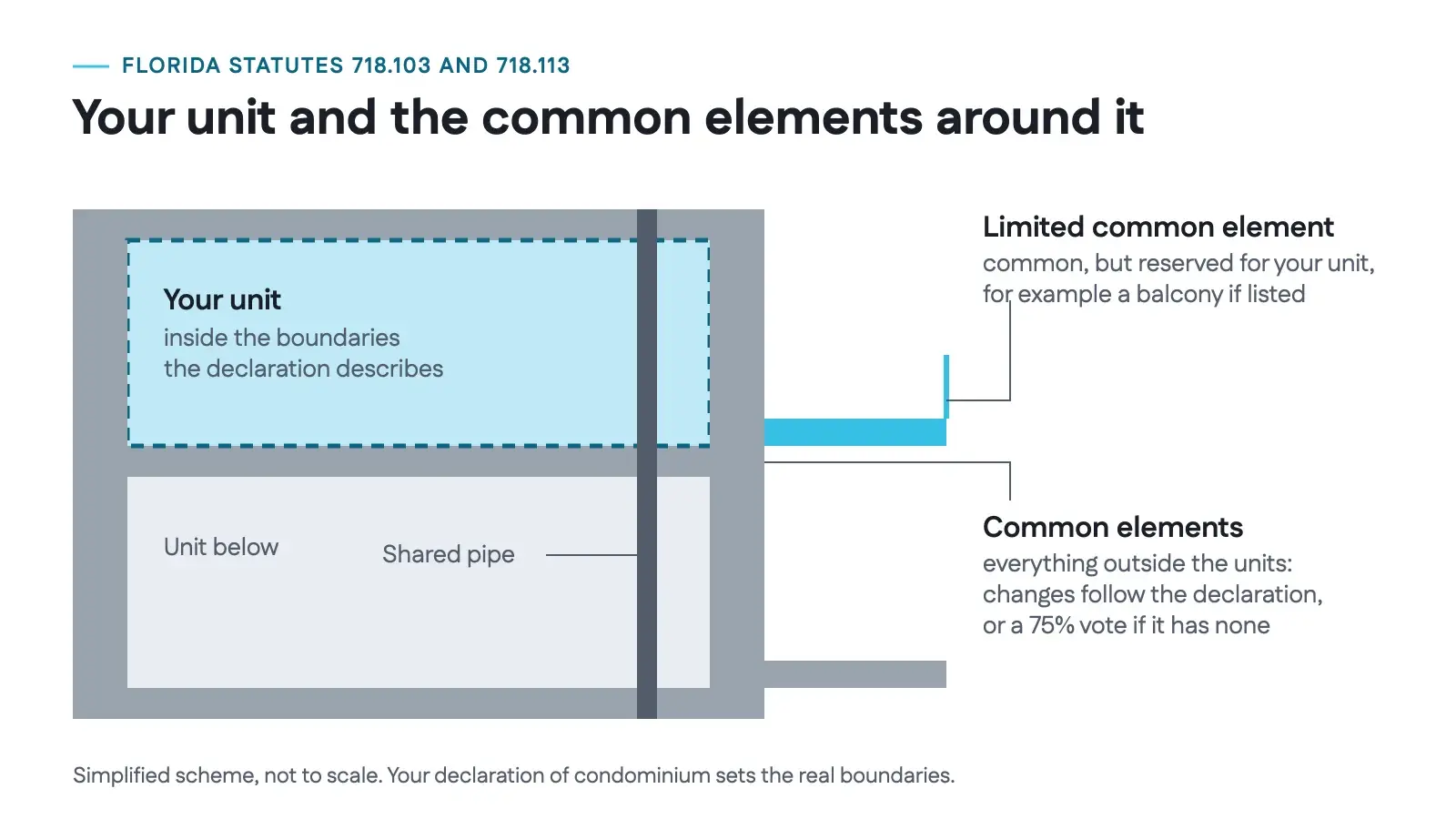
Altering common elements takes a vote. Under section 718.113(2)(a), a material alteration of the common elements follows the procedure in the declaration. If the declaration has none, 75 percent of the total voting interests must approve it before work starts.
Which condo renovations need association approval, a permit or both?
In unincorporated Miami-Dade, paint, tile, carpet and cabinets need no permit, so they usually need only the association's sign-off, if its rules ask for one. Electrical, gas, mechanical and plumbing work needs a building permit as well, and in unincorporated Miami-Dade so does removing a wall. Work on common elements goes through the declaration or the 75 percent vote described above.
The permit column below follows the Florida Building Code (FBC) and Miami-Dade County's guidance for unincorporated areas. The association column is general: your declaration and building rules decide what needs written approval.
The county's exemption guideline is dated December 26, 2018, and FBC section 105.2 adds that an exemption from a permit does not authorize any work that violates the code. Confirm the current list with your building department before you buy materials.
How do you get condo association approval for a remodel?
Read the declaration and the renovation rules, submit the association's application and wait for written approval. Then apply for the permit, do the work under the building's rules and pass the permit inspections. That order is how to remodel a condo without having the work stopped or redone.
- Ask the association in writing for the declaration and the current rules. The association keeps both among its official records and must make them available within 10 working days of a written request.
- Fill in the association's application, with drawings, the contractor's details and a schedule if the building asks for them. Some larger associations meet only monthly, so send it early. One Miami contractor's guide (April 2026) says board approval can take about two to six weeks.
- Hold off until you have the approval in writing. Miami-Dade's permit application states that a permit does not relieve the owner from obtaining association approval before work begins.
- File the permit application with the building department, attaching the approval letter where the city requires it.
- Do the work under the building's rules on hours, elevators and protection of common areas, and book each permit inspection as the work reaches that stage.
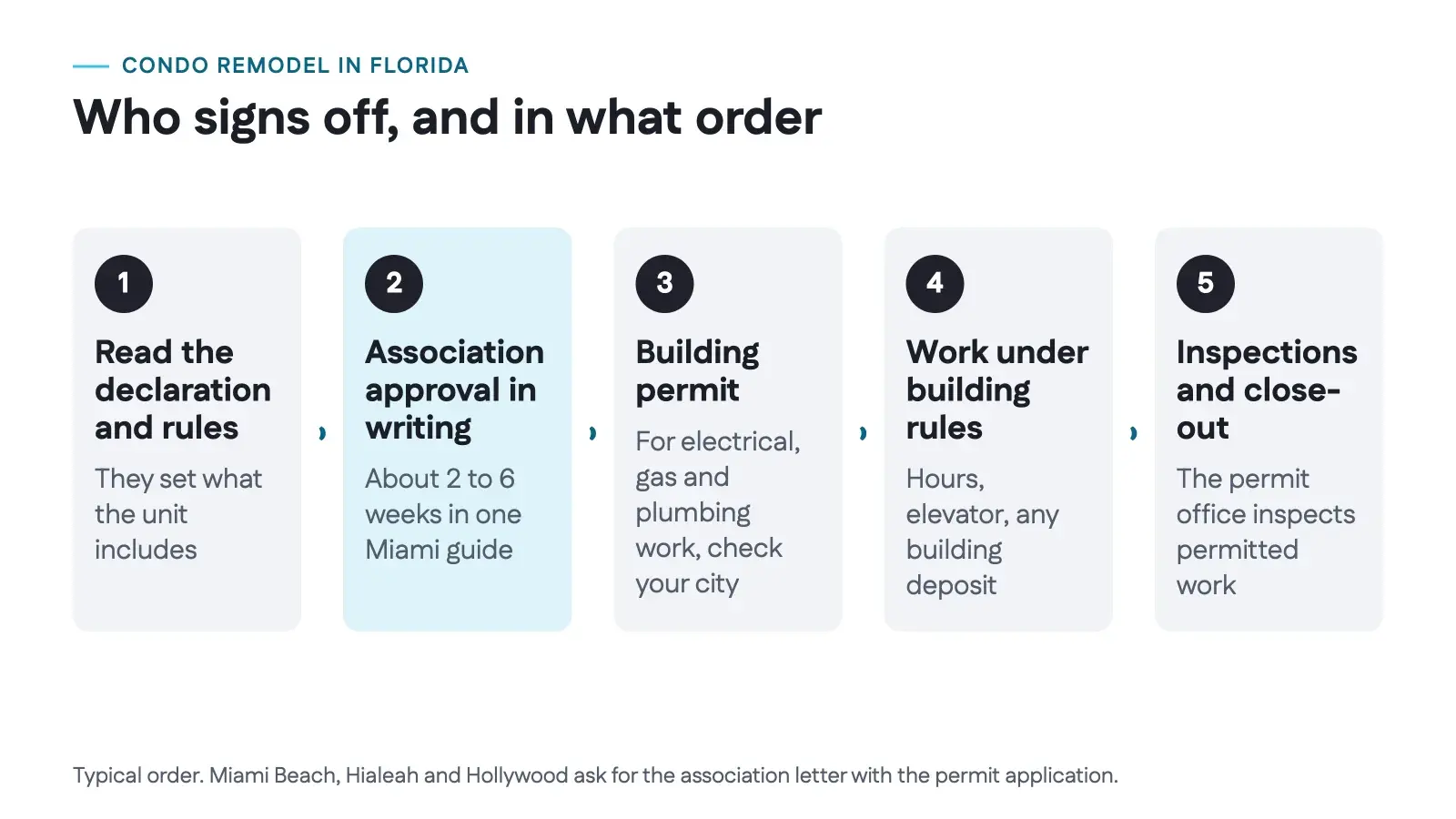
If the board turns the application down, ask for the reason in writing. Then compare it with the declaration and rules from step 1, because the board acts under those documents. If your plan touches common elements, the vote comes before any of these steps.
When do you need a building permit for a condo remodel in Florida?
You need a permit before you alter a building or replace electrical, gas, mechanical or plumbing systems. It comes from your city's building department, or from Miami-Dade County in unincorporated areas, and several cities want the association letter with the application.
FBC section 105.1 sets the rule. Before you construct, alter, repair or move a building, you or your agent must apply to the building official and get a permit. The same applies before you install, alter, repair or replace impact-resistant coverings or electrical, gas, mechanical or plumbing systems.
Which office issues it depends on the address. The Miami-Dade County permit process applies only to unincorporated Miami-Dade, and every municipality has its own building official who issues permits within city limits.
Three cities spell out the association letter in their own documents:
- Miami Beach: since March 14, 2022, the Building Department requires an authorization letter from the condominium association for any work in the building's units. Its checklist asks for a board approval letter on letterhead, signed and notarized.
- Hialeah: an application for a condominium needs the association's authorization letter, with the president's signature notarized.
- Hollywood: the alteration checklist asks for an association approval letter and an affidavit of awareness of homeowners' association.
For other cities in Broward and Palm Beach County, ask the building department what it wants with the application. Some may ask for the same letter, and some for something different.
Why do floors cause trouble in condo remodels?
A hard floor carries footsteps into the unit below, so sound ratings can matter when flooring changes. Miami-Dade's insulation certificate form lists STC 50 and IIC 50 for assemblies between dwelling units, and some buildings add their own floor rules.
The form requires walls, partitions and floor and ceiling assemblies between dwelling units to have a sound transmission class (STC) of at least 50. Floor and ceiling assemblies between units also need an impact insulation class (IIC) of at least 50. STC describes how well an assembly blocks airborne sound such as voices. IIC describes how well it blocks impact sound such as footsteps.
Tile on a bare slab needs no permit in unincorporated Miami-Dade, as the table shows, yet the floor rules of your building can still apply. Before you order, ask the association for its floor rules in writing and ask the supplier for the underlayment's tested ratings.
Can you replace windows, sliding doors or hurricane shutters in a condo?
Usually yes, within your association's hurricane protection specifications. Florida law requires the board to adopt them, and the board may not refuse an installation that conforms, though it can require the same look as the rest of the building.
Section 718.113(5) requires the board of a residential condominium to adopt hurricane protection specifications for each building, and they must comply with the applicable code. If the condominium documents require approval, the board may not refuse an owner's installation or replacement of hurricane protection that conforms to its specifications. It may require the owner to follow an existing unified scheme for the building's exterior appearance.
Whether your windows and balcony door belong to the unit or to the building is set by your declaration, so look for them in the unit description before you order.
Shutters and other impact-resistant coverings are on the permit list in FBC section 105.1. For windows and sliding doors, ask your building department. In Miami-Dade, also check the product's Notice of Acceptance. This county document states that the product is approved and designed to comply with the Florida Building Code, including the High Velocity Hurricane Zone.
Who can do the work in a condo, a licensed contractor or the owner?
Permitted work in Florida is done by a licensed contractor or by the owner acting as their own contractor, which the statute calls an owner-builder. The owner-builder exemption names one-family and two-family homes, so for a condo unit check with the building department and the association first.
Section 489.103(7) lets an owner build or improve a one-family or two-family residence for their own occupancy, if it is not offered for sale or lease. A sale or lease within 1 year after completion creates a presumption that the work was done for sale or lease. The exemption names those residences, farm outbuildings and commercial buildings up to $75,000. It does not list a condominium unit as a general category.
Where the owner-builder route is open, the owner must personally appear and sign the permit application.
The owner cannot hand supervision to someone who is not registered or certified, and the exemption does not cover anyone the owner hires to act as a contractor. The state's disclosure statement says the owner is the responsible party of record on the permit. In unincorporated Miami-Dade, permits are issued in the name of the person doing the work.
Because an owner-builder must appear in person, an owner who lives outside Florida can instead hire a licensed contractor and have the permit filed in the contractor's name, which the disclosure statement names as a way to reduce financial risk.
Three more rules affect who you hire. An unlicensed contractor cannot enforce the contract, and acting as a contractor without a license is a first-degree misdemeanor. A residential improvement contract must include a written notice about the Florida Homeowners' Construction Recovery Fund unless labor and materials come to $2,500 or less. Under the EPA Renovation, Repair and Painting rule, paid work that disturbs paint in homes built before 1978 must be done by certified firms.
What are the risks of remodeling a condo without approval or a permit?
The association can fine you up to $100 per violation and $1,000 in total, and suspend your use of common areas. On the permit side, a 2022 Miami-Dade memo, quoting the county code, says work started before the permit carries double permit fees.
A fine needs process first. Under section 718.303, the board must give you at least 14 days' written notice. You then get a hearing before a committee of at least three members, none of them an officer, director or employee of the association. A fine may not become a lien, a legal charge on the property, against your unit.
A suspension has limits too. It cannot cover limited common elements meant only for your unit, the common elements you need to reach the unit, utility services, parking spaces or elevators.
Beyond fines, the association or another owner can go to court to enforce the declaration, as section 718.303 allows.
Florida Statutes 489.127 prohibits starting work that needs a permit without the permit in effect, and the state may issue a stop-work order for unlicensed work. A person who starts early pays a fee set by the building official on top of the permit fees (FBC section 109.4). Confirm Miami-Dade's current rate with the county before you count on any figure.
How do Florida's newer condo safety laws affect your remodel?
Buildings of three or more habitable stories need a milestone inspection and a structural integrity reserve study. Repairs these reports find can lead to special assessments, which compete with your remodel budget.
A residential condo building of three habitable stories or more needs a milestone inspection. The deadline is December 31 of the year it reaches 30 years from its certificate of occupancy, and the inspection repeats every 10 years. A local agency may set 25 years where conditions such as nearness to salt water call for it. In 2025, House Bill 913 revised which buildings need one.
The structural integrity reserve study is a report on the building's main systems, done at least every 10 years. It covers the roof, structure, plumbing, electrical systems, waterproofing, and windows and exterior doors, among other items.
Reserves can be funded by regular or special assessments, lines of credit or loans. A special assessment is an extra charge to owners. A special assessment, line of credit or loan needs a majority vote of the total voting interests. Ask the association for the latest study before you set a remodel budget.
How long does a condo remodel take and what should you budget?
Florida Home Build plans a full condo unit renovation at 3 to 8 months, counted from the date permits are issued and materials arrive, and quotes $150 to $350 per square foot. The timeline is a plan and is not guaranteed.
Board review and permit review come before that clock starts. Permit review time depends on the city, so ask your building department for its current timeline when you plan dates. The price covers a turnkey renovation, meaning one contractor runs the whole job from approvals to the final inspection. It does not include design, permit fees or furniture.
The company works in the same three counties and handles the city and county permits, the inspections and the condo association applications for the owner. Its request form starts at a budget of about $250,000. The contract is cost plus a fixed fee with a price cap: you pay actual costs plus a set fee, and the contractor pays any overruns above the cap.
For a full unit, the page on turnkey condo renovation in Miami shows how that service works. If you also own a house, the article on whole house renovation costs covers the figures for houses.
This guide summarizes public rules and Miami-Dade permit guidance as of November 2026 and is not legal advice. Your declaration and your building department have the final word.
Frequently asked questions
Can I remove a wall in my condo?
Maybe. First find out from the declaration whether the wall belongs to your unit or is a common element, because no owner may harm the safety or soundness of the common elements. A wall that is yours usually still needs the association's written approval under the declaration and rules, and in unincorporated Miami-Dade it needs a building permit.
Does a condo association charge a deposit to approve a remodel?
Many buildings do. One Miami contractor's guide (April 2026) says buildings often take a construction deposit of $5,000 to $10,000, refundable after a final inspection, and suggests budgeting $2,000 to $5,000 for building logistics. Your building sets its own figures, so ask the management office for the current schedule.
What if the association does not send me the declaration and rules?
Keep a copy of your written request. If the association misses the 10 working day deadline, the law presumes the failure was willful. You can then seek minimum damages of $50 per calendar day for up to 10 days, starting on the 11th working day.
Is it harder to renovate a condo than a house?
A condo adds an association layer to the permit, so paperwork and timing often differ from a house. Work hours can be tighter too. In Miami Beach residential zones, construction noise is allowed on weekdays from 8:00 a.m. to 6:00 p.m. and on Saturdays from 10:00 a.m. to 4:00 p.m., never on Sundays.
Will the 2026 Florida Building Code change my condo permit?
It can. The 9th Edition (2026) of the Florida Building Code takes effect on December 31, 2026, and Miami-Dade permit applications and plans submitted on or after that date must comply with it. Ask your building department which edition applies to your submission date before your designer finishes the drawings.
04.11.2026